

Prediction Markets Are Not God
Prediction markets can tell us something. They cannot tell us everything.

Politics attracts two kinds of fools.
The first fool believes only in feelings. This person watches a candidate give one good speech, post one beautiful launch video, or say something brave on television, and suddenly we have found the next Obama, the next Fetterman, the next AOC, the next savior of democracy, the next person who will finally explain rural broadband in a way that makes MSNBC cry.
The second fool believes only in numbers. This person sees a prediction market, a poll average, a model output, or a tidy little probability score and decides the future has been revealed from on high.
Both are wrong.
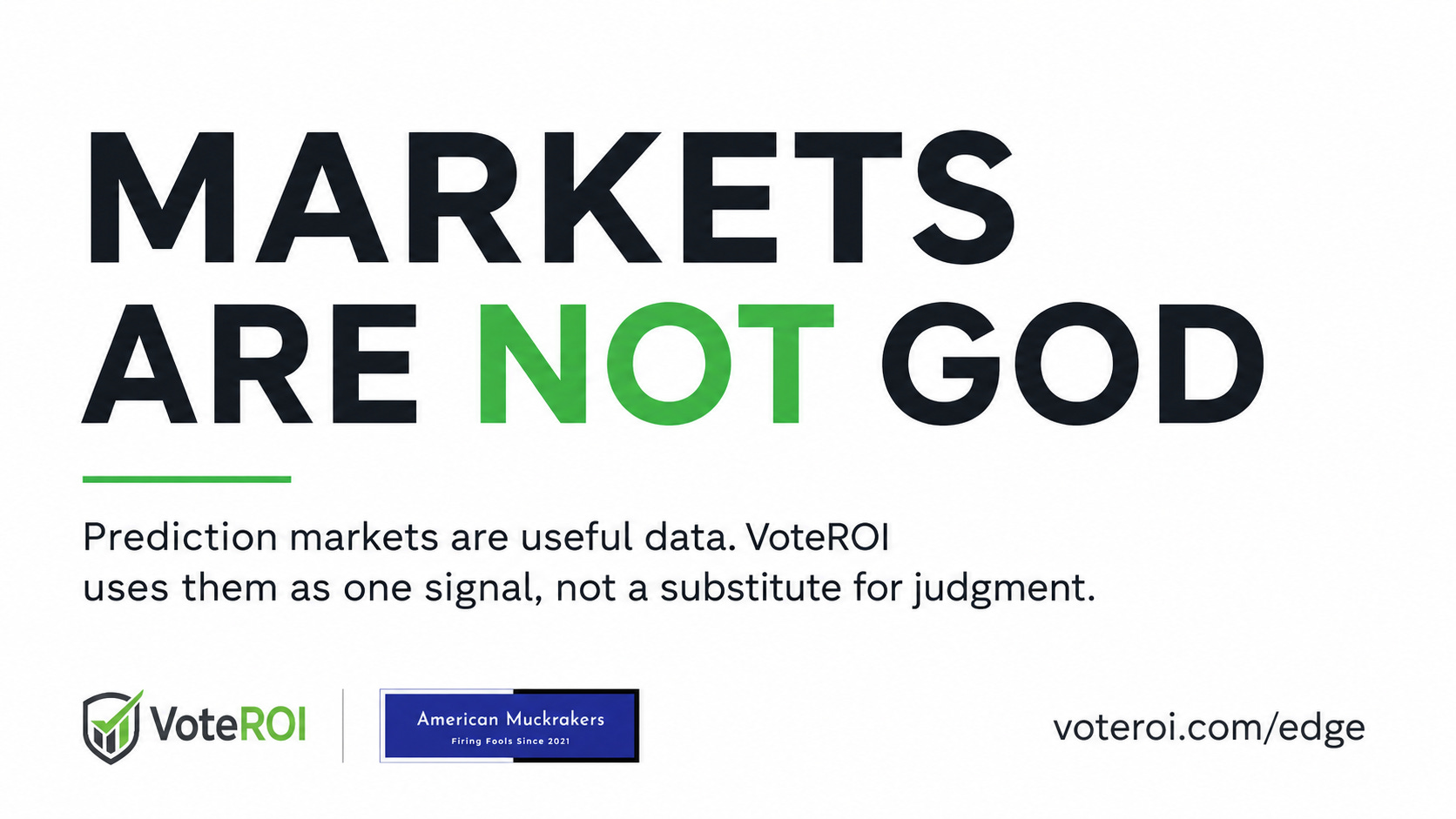
Feelings are not strategy. Markets are not God.
The truth is harder, messier, and far more useful. Political judgment requires data, context, timing, local knowledge, skepticism, and humility. A prediction market can tell us something important about what people with money at risk think may happen. It can help us see where expectations are moving. It can puncture fantasy. It can also miss the story entirely.
A market cannot see every local scandal before the locals start whispering about it at the diner. It cannot feel whether a candidate is actually working. It cannot know whether a district is sleeping, shifting, or waiting for somebody to show up with a real message and enough money to deliver it. It cannot tell whether a race is dead, neglected, misunderstood, or mispriced.
That is why VoteROI uses prediction markets carefully.
Not as commandments.
As signals.
What A Prediction Market Actually Is
A prediction market is basically a place where people put money behind what they think will happen.
Instead of asking a pundit, “Who do you think wins this race?” a market asks a better question: “What price are people willing to pay for a contract that pays out if this candidate wins?”
That price can be translated into an implied probability. If a contract trades around 60 cents, the market is roughly saying the event has about a 60 percent chance of happening. If it trades around 20 cents, the market is saying the outcome is possible but unlikely. If it trades around 90 cents, the market thinks the result is close to baked in.
That can be useful.
A prediction market can aggregate scattered information quickly. It can react faster than formal polling. It can capture what politically engaged people, analysts, bettors, obsessive weirdos, insiders, and semi-insiders think is changing before that change shows up in a public model.
It can also discipline wishful thinking.
If every donor on Twitter thinks a race is tied, but the market prices that candidate at 12 percent, that does not end the conversation. But it should start one.
Maybe the market is wrong. Maybe the market is thin. Maybe the market has not caught up to a real shift. Maybe the candidate is being underestimated.
Or maybe the campaign is selling hope because hope raises money.
That is the point.
A prediction market is not valuable because it tells us what to think. It is valuable because it gives us something to interrogate.
The Gap Between The Story And The Price
Political campaigns are story machines.
Every campaign says it is surging. Every fundraising email says the race is close. Every consultant has a poll. Every candidate is apparently one more ad buy, one more mail piece, one more viral clip, one more emergency midnight deadline away from shocking the world.
And sometimes that is true.
Sometimes a campaign really is being underestimated. Sometimes the smart money is late. Sometimes national analysts miss what locals already know. Sometimes a candidate with a weak-looking number is actually building something real.
But sometimes the campaign is just selling a story.
That is where markets can help. They force us to ask whether the story and the price match.
If a candidate is supposedly on the verge of winning, but the market still treats the candidate as a severe long shot, donors should slow down and ask why. Not because the market is automatically right. Because the gap itself is interesting.
The useful question is not, “Should we obey the market?”
The useful question is, “What does the market see, what does it miss, and why does that matter?”
That gap is where intelligence lives.
Why Markets Are Useful
Markets are useful because politics is full of noise, and Democrats are very good at creating noise that sounds like momentum.
A campaign can manufacture buzz. It can buy ads. It can push a flattering internal poll. It can flood inboxes. It can make a race feel more competitive than it is. It can turn one good debate clip into a national donor fantasy. It can convince thousands of people that a heroic candidate is one money bomb away from flipping a district that still votes like it was carved out by a man wearing a Reagan button.
A market, at least in theory, asks people to put money on the claim.
That matters.
Not because markets are pure. They are not. Not because bettors are geniuses. Many are not. Not because money always finds truth. Please look around America and reconsider that sentence.
Markets matter because they create a different kind of signal. They ask what people are willing to risk, not just what they are willing to say.
That signal should not be worshiped.
But it should not be ignored.
Why Markets Are Not God
Prediction markets can be wrong in all the usual human ways, plus a few extra dumb technological ways.
They can be thinly traded. If only a small number of people are participating, the price may reflect a narrow crowd rather than deep knowledge.
They can be distorted by attention. High-profile races attract more money, more speculation, and more noise. Low-profile races may be badly priced because almost nobody is paying attention.
They can lag local reality. A candidate knocking doors in rural counties, a local scandal, a weak incumbent, a toxic endorsement, a county-level turnout operation, or a late organizing surge may not show up in a national-facing market until much later.
They can mistake probability for inevitability. A candidate with a 70 percent chance of winning still loses 30 percent of the time. A candidate with a 20 percent chance is not dead. That number means hard, not impossible.
Markets can also inherit the blind spots of the people trading them. If the crowd is narrow, coastal, over-online, male, crypto-heavy, finance-heavy, politically weird, or trapped in the same media bubble, then the market may simply convert a shared blind spot into a price.
That is not prophecy.
That is groupthink with a ticker.
So no, I do not worship markets.
Nobody should.
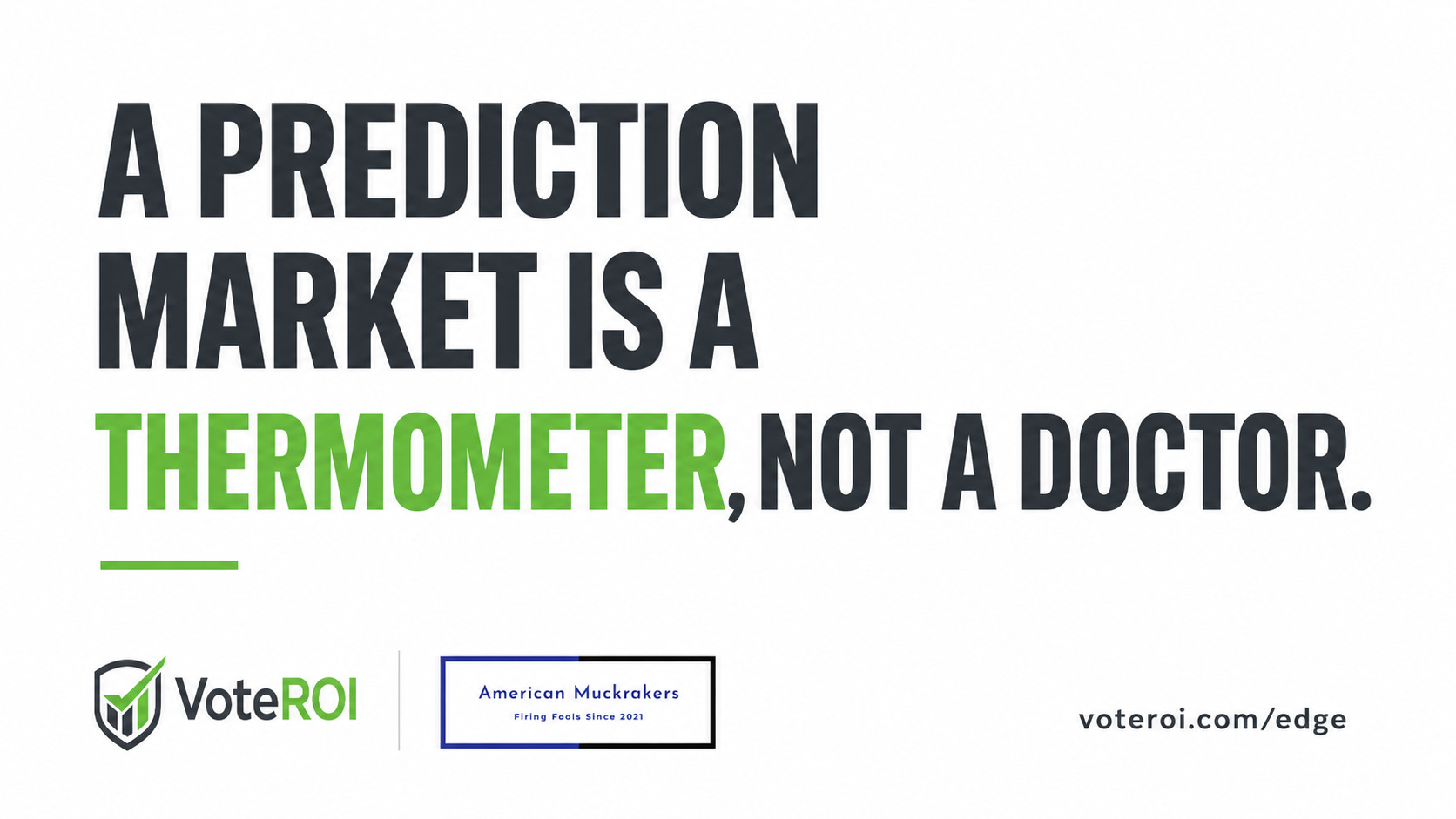
A prediction market is a thermometer, not a doctor. It can tell you something about the temperature. It cannot diagnose the whole patient.
The Donor Question Is Different
This is where most political donors, consultants, and amateur election prophets get tangled up.
The question is not only, “Who is likely to win?”
That is an interesting question. It is also not always the most important donor question.
The better donor question is:
Where can another dollar still matter?
Those are not the same thing.
A candidate with a 90 percent chance of winning may be wonderful, important, and morally correct. But your donation may not matter much. The race may already be functionally decided. Giving there may feel good, but it may not be the best use of scarce political money.
A candidate with a 5 percent chance may be brave, admirable, and exactly the kind of person you wish represented more of America. But your donation may also not matter much if the race is structurally unwinnable.
In Landman, Billy Bob Thornton’s character, Tommy Norris, talks about oil prices needing to live in a sweet spot: high enough for producers to keep drilling, low enough that regular people do not feel punched in the face every time they fill the tank. That is exactly how donors should think about political markets. A number can tell you where the pressure is. It can tell you whether the system is too cold, too hot, or somewhere in the useful middle. But the number is not God.
The sweet spot is where the signal, the reality on the ground, and the opportunity for action all meet. That is what VoteROI is trying to find in politics: not the hottest race, not the loudest race, and not the one that makes donors feel the best, but the race where the price, the odds, and the moment suggest another dollar can still do real work.
The sweet spot is often somewhere in the middle: races where the outcome is uncertain, the candidate is credible, the opponent is vulnerable, the funding gap is real, and additional money can still buy meaningful communication, organizing, persuasion, or turnout.
That is opportunity.
VoteROI is built around opportunity, not just probability.
We are not trying to help donors chase obvious winners after everyone else has already noticed them. We are trying to help donors find races where support can still affect the path. That’s the difference between strategic donating (VoteROI) and blind giving (Actblue).
That is a different project.
And frankly, it is the project Democrats should have built years ago.
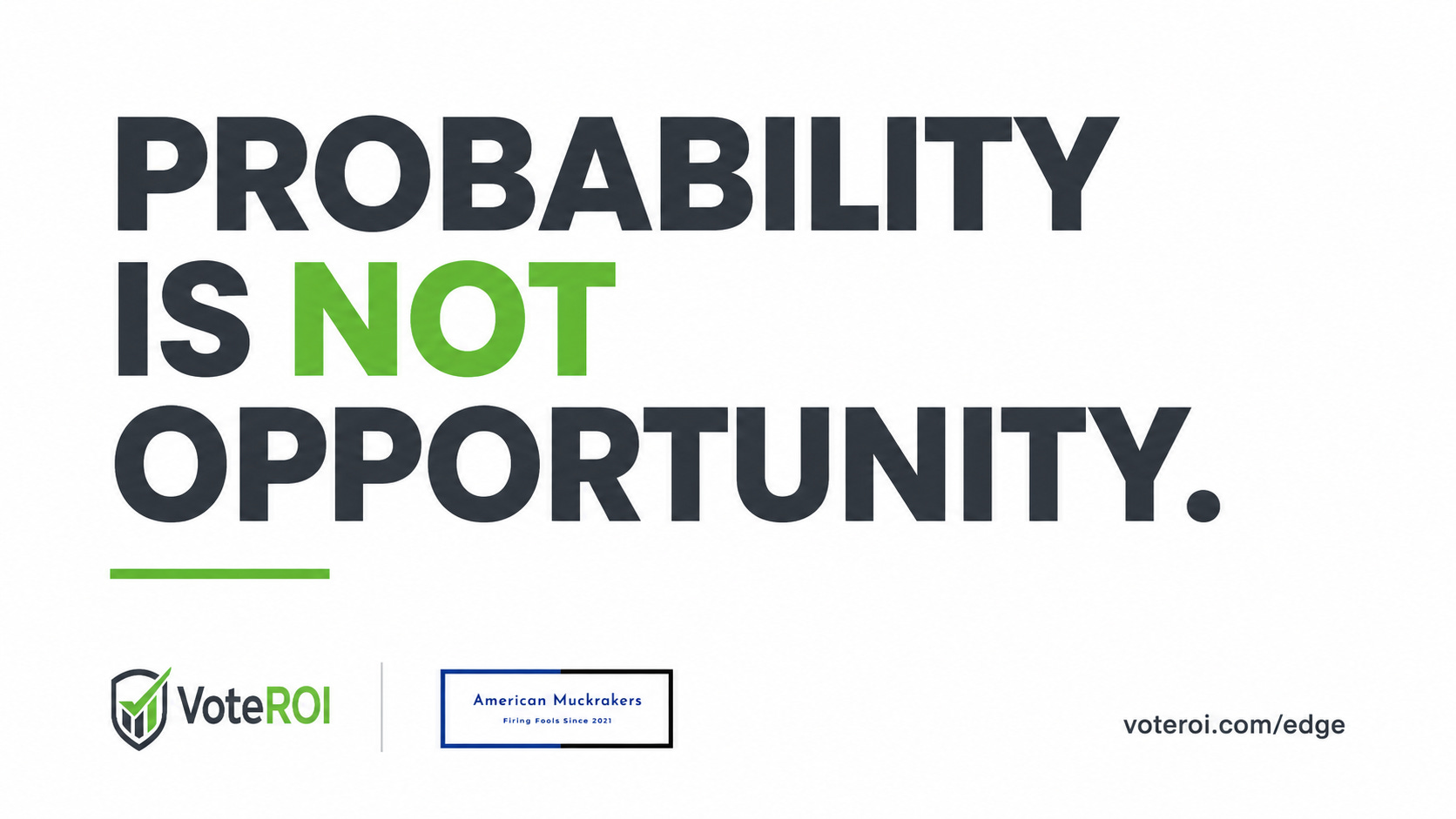
Probability Is Not Opportunity
Win probability and donor opportunity are related, but they are not twins.
A race can be close but already saturated with money. Another $50 may disappear into an ocean.
A race can be a long shot but still worth funding because early money could define the candidate, expose a weak opponent, build name recognition, or create infrastructure before the national committees wake up.
A race can look promising in a market but still be a poor donor target because the candidate is already well funded, the media market is too expensive, or the campaign lacks the operation to turn money into votes.
A race can look weak in a market but deserve attention because the market has not caught up to local facts.
This is the distinction too many fundraising emails refuse to make. They want every race to be urgent, every candidate to be viable, every donation to be heroic, and every deadline to be the last one before civilization collapses into a puddle.
That is not strategy.
That is theater with a donate button.
How VoteROI Uses Markets

VoteROI uses prediction markets as one input in a larger donor-intelligence process.
We look at markets because they help measure outside expectations. They can show whether a race is being treated as competitive, hopeless, overlooked, or mispriced. They can reveal movement. They can show when a candidate’s perceived chances are rising or falling.
But we do not stop there.
Markets are combined with polling, fundraising data, candidate quality, district context, national environment, race importance, donor sensitivity, and marginal-dollar value.
That last phrase matters.
Marginal-dollar value means we are asking whether the next dollar can still do work. Not whether the candidate is lovable. Not whether the race makes us feel noble. Not whether the email subject line scared us into clicking.
Can the next dollar still move something?
Can it help reach voters who have not been reached? Can it fund rural radio where nobody else is talking? Can it close a gap in a race that is actually close? Can it help define an opponent before the opponent defines themselves? Can it force the other side to spend? Can it turn a neglected race into a live one?
That is what donors should want to know before they give.
Donors Are Busy, Not Stupid
Most donors do not have time to read every FEC report, compare market movement, parse polling methodology, analyze district trends, examine turnout history, evaluate candidate quality, and then decide whether a race is actually viable.
That does not mean they are dumb.
It means they have lives.
They have jobs, families, mortgages, businesses, kids, parents, health problems, and all the other daily joys of being alive in a country where half the political class appears to have been raised by raccoons in a parking lot.
So donors rely on shortcuts.
A trusted friend. A viral clip. A dramatic email. A candidate who feels right. A party committee. A headline. A poll. A market. A model.
Shortcuts are unavoidable.
The question is whether we can build better ones.
VoteROI is an attempt to build a better shortcut. Not a perfect shortcut. Not a magic shortcut. A more honest shortcut.
It gives donors a way to see where a race stands before they give. It gives them a way to compare races. It gives them a way to ask whether a donation is likely to be useful, not merely satisfying.
That matters especially for people who have never donated before, and for people who stopped donating because they felt burned.
Skeptical donors are not the enemy.
They are exactly the people we need back.
Why This Matters After Years Of Blind Giving
Democrats have a bad habit of confusing fundraising with winning. I wrote about that in a prior post.
We look at a giant quarterly number and treat it like proof of momentum. Sometimes it is. Sometimes it is just proof that a campaign hired a good email vendor and discovered how many times a donor will tolerate being told democracy dies at midnight.
Money matters, but where the money lands matters more.
A million dollars in the wrong race can be a bonfire. Fifty thousand dollars in the right race can be the difference between silence and voter contact. I’ve written about this in a prior post too. Ten thousand dollars at the right moment can help define an opponent, fund a rural radio buy, hire organizers, or keep a campaign alive long enough to catch a break.
That is why prediction markets matter, but also why they are not enough.
Markets can help tell us how the world is pricing a race. They cannot tell us whether a particular donation has strategic value.
That is the missing layer.
That is what VoteROI is trying to build.
The Edge Campaign Connection
This is also why American Muckrakers created the Designated Edge Campaign label.
The label is not a guarantee.
It is not a coronation.
It is not a statement that the market, the model, or I have discovered the will of God while drinking coffee and yelling at a spreadsheet.
It means we believe a race deserves donor attention because the combined evidence suggests money may still move the outcome.
At voteroi.com/edge, we list a curated slate of these races. Each card gives donors a starting point: the candidate, the office, the win-probability estimate, the opportunity score, the fundraising goal, and a short explanation of why the race deserves attention.
Curated matters.
We are not trying to list every Democrat. That already exists. We are trying to help donors think through where their money may still do work.
Some races will appear. Some will drop off. Some will improve. Some will fade. That is not a bug. That is the point.
Politics changes. The page should change with it.
Smart Giving Is Not Cynicism
None of this means we should abandon courage, long shots, or candidates who are early, underfunded, or underestimated.
Quite the opposite.
Better donor intelligence can help us spot the right long shots sooner. It can help us separate races that are difficult from races that are dead. It can help us fund candidates before the national committees wake up. It can move money into neglected races where the next dollar has more force.
That is not cynicism.
That is respect.
Respect for donors. Respect for candidates. Respect for the stakes.
Cynicism says nothing matters.
Discipline says some things matter more than others.
VoteROI is built for discipline.
Look At The Signals Before You Give
Prediction markets are useful. Polling is useful. Fundraising data is useful. Candidate history is useful. Local context is useful. None of them is enough alone.
That is the point.
Do not donate because a market moved.
Do not donate because a model blinked.
Do not donate because a campaign screamed.
Do not donate because a candidate made you feel good for ninety seconds.
Look at the signals together. Ask whether the race can move. Ask whether the candidate can use the money. Ask whether the opponent is vulnerable. Ask whether the district is reachable. Ask whether the next dollar still matters.
Then decide.
The values are yours. The judgment is yours. VoteROI just tries to put better information in front of you before the money leaves your account.
Markets are not God.
But ignoring data is not virtue.
We beat the MAGA money train by getting smarter about where our money goes. That means fewer blind donations, more disciplined giving, more honesty, more context, and more donors who know what they are funding before they fund it.
That is why we use prediction markets.
That is why we do not worship them.
And that is why VoteROI exists.
About the Author
David B. Wheeler is President and Co-Founder of American Muckrakers and a candidate for Clerk of Superior Court in Mitchell County, North Carolina. His views are his own, and written directly by David, with spell checking and minor edits with the help of his AI buddy. An essay or story is never independently generated by AI and posted. That would be just stupid. David successfully sued Beetlejuice Boebert for defamation in 2024.
Disclaimer
Paid for by American Muckrakers Independent Expenditure PAC. Not authorized by any candidate or candidate’s committee.
This essay constitutes protected speech and commentary, opinion, and advocacy on matters of public concern under the First Amendment to the United States Constitution. It is not a legal pleading, sworn statement, affidavit, or admission of fact, and it does not purport to describe evidence, discovery, or litigation strategy. This commentary is not intended to influence any pending judicial proceeding. Nothing herein waives any rights, concedes any legal position, or limits the author’s ability to pursue or defend lawful claims in any forum.