
The Most Dangerous Lie in Democratic Politics: "This one was different."
On April 7, 2026, Democrats got another shot at the district once held by Marjorie Taylor Greene.
Special election.
Lower turnout.
National attention.
An opponent people love to hate.
For a moment, the story wrote itself:
Maybe this is the one.
This time—it almost looked believable.
And that’s exactly why this race is dangerous.
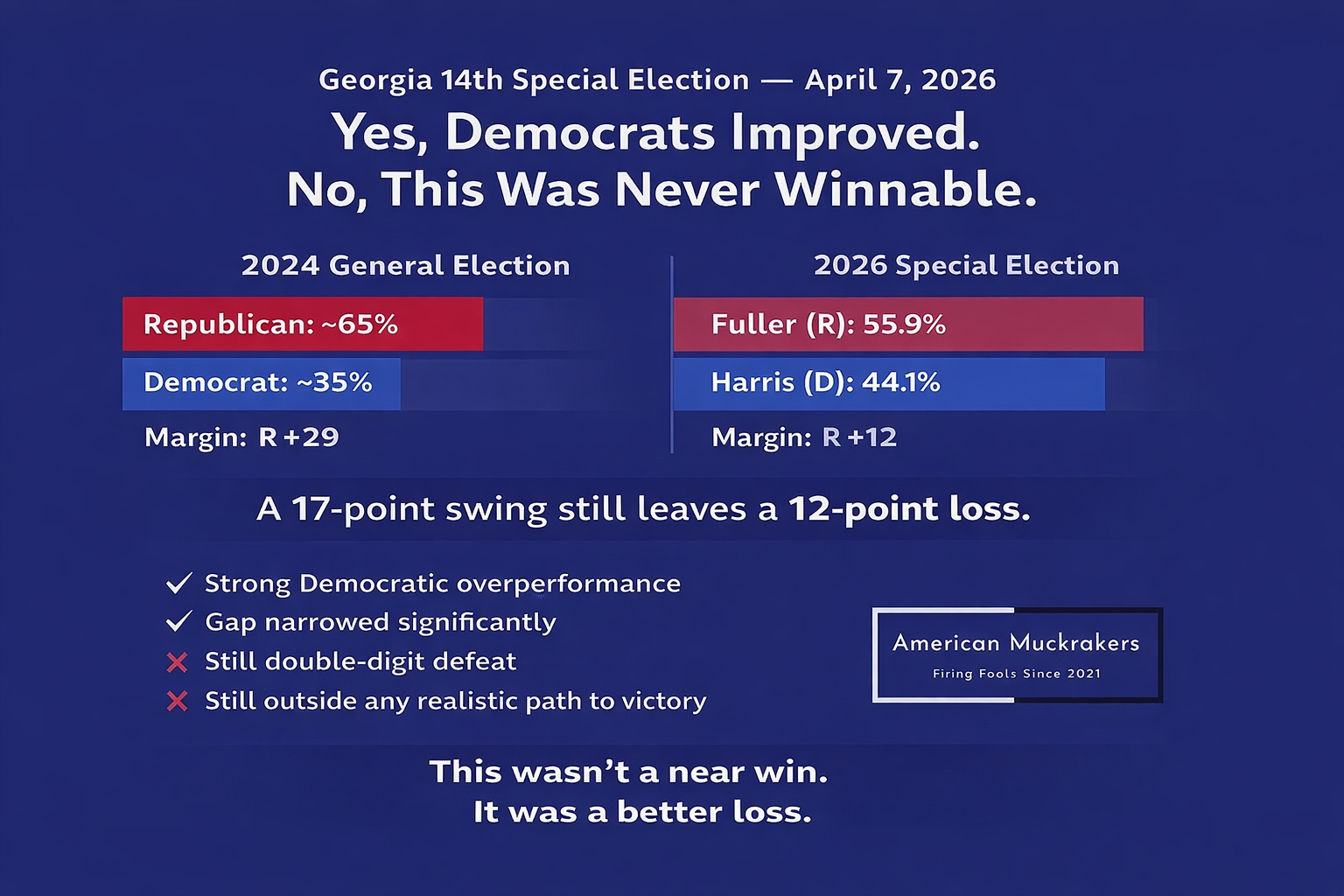
The Result
Here’s what actually happened:
Republican: 55.9% (72,304 votes)
Democrat: 44.1% (57,030 votes)
Margin: R +12
That is a dramatic improvement over prior cycles.
And it still wasn’t close enough to win.
First—Let’s Be Clear About One Thing
Shawn Harris ran a strong race.
Full stop.
Serious effort.
Real campaign.
Clear overperformance.
This is not about the candidate.
This is about the map.
Why This Result Is More Dangerous Than a Blowout
Blowouts are easy to ignore.
This wasn’t a blowout.
This was a convincing loss.
The kind that:
Feels competitive
Looks flippable
Generates donor excitement
And still leaves you firmly outside the range where elections actually flip.
What Actually Changed
Let’s be honest:
This was real movement.
Compared to baseline:
2024 General: ~R +28–30
2022: ~R +32
2020: ~R +49
April 7, 2026:
👉 R +12
That’s roughly a 16–18 point shift.
That is not noise.
That is not spin.
That is real performance.
And It Still Didn’t Matter
This is the part Democrats refuse to process.
Even after a massive shift:
👉 Democrats still lost by double digits.
Not 1–2 points.
Not recount territory.
Not inside striking distance.
Still outside.
The Illusion
This is where the system breaks.
Because now the narrative becomes:
“We’re getting closer”
“Another push and we flip it”
“This is now a target district”
No.
Let’s be precise:
Movement is not the same as viability.
The Only Question That Matters
Did this race move into a range where additional dollars could reasonably change the outcome?
No.
At R +12, you are still:
Outside normal swing range
Dependent on a perfect storm
Structurally behind
That is not a rational investment target.
What This Actually Proves
The April 7 election didn’t show a path.
It showed a ceiling.
👉 This is how far the numbers can move—and still not be enough.
The ROI Reality
Let’s talk about what this cost.
Millions were raised.
Millions were spent.
National attention poured in.
What did that buy?
~18 points of improvement
Still a 12-point loss
That is not failure of effort.
👉 It is misallocation of capital
The Most Dangerous Category in Politics
This is the real trap:
👉 Races that can improve dramatically—and still not be winnable
They:
Justify more spending
Attract more donors
Create the illusion of momentum
And never actually flip
These are worse than blowouts.
Because they’re believable.
The Incentive Problem
No one inside the system will say:
“Don’t fund this race.”
Because:
“We closed the gap” raises money
Progress narratives sell
Vendors still get paid
A 30-point loss is ignored.
A 12-point loss is marketed.
The Opportunity Cost
Every dollar spent here:
Did not go to:
A true toss-up district
A +3 or +5 race
A state-level seat that changes power
This isn’t harmless.
👉 It’s displacement of winning capital.
The Bottom Line
April 7 didn’t prove Democrats are on the verge of flipping this seat.
It proved something much more important:
👉 Even a strong candidate and a well-run campaign cannot overcome structural reality in this district—yet.
And until Democrats learn to distinguish between:
“We ran a great race”
and“We can win this race”
they will keep investing in losses that feel like progress.
A Final Thought
This isn’t about criticism.
It’s about clarity.
A strong candidate ran a strong race and proved something important:
👉 How far the numbers can move in this district.
Now comes the harder question:
Where do the next dollars actually change outcomes?
Because until we start answering that—honestly, consistently, and with data—
we will keep confusing effort with impact,
and progress with victory.
That’s the problem.
And it’s solvable.
About the Author
David B. Wheeler is President and Co-Founder of American Muckrakers PAC, focused on accountability, investigative research, and strategic exposure of public officials and candidates.
He has spent more than 40 years building organizations, advising leaders, and executing high-impact campaigns across more than 50 countries and all seven continents.
He is also the founder of Parallax Advisory and the architect behind VoteROI, a platform designed to bring data-driven discipline to political donor decision-making.
Disclaimer
The views expressed here are those of the author and do not necessarily reflect the views of any organization, client, or affiliated entity. This publication is for informational and commentary purposes only and should not be construed as legal, financial, or political advice. Election data referenced is based on publicly reported results and may be subject to final certification.


Hey David, This is great. I’ve been hearing this argument about not investing capital in a race that cannot be won. The organization I heard talk about it is Swing Left. They have a financial strategy and a powerful ground game.
I’m down here in Florida, FL13. Rep Anna Paulina Luna (R). She was a Maxim model before becoming a Congresswoman. She is a Trump Republican. She posted on Instagram that people protesting in No Kings are members of the CCP. I am one of those protesters. I looked up CCP. Chinese Communist Party. WTH? Does she believe this or is she diabolical?
At any rate, we have 2 great candidates who are smart and care for people to run against her, Brandt Robinson and Earle Forde.
No one at the national level has mentioned targeting Luna’s seat as “winnable”
Here, in the heart of desperation, in the MAGA breeding swamp which is Florida, we really hope these candidates have a shot. Considering Swing Left has not named this race as “winnable”, is the answer to cease and desist fundraising, campaigning?
Was that the answer in GA?