
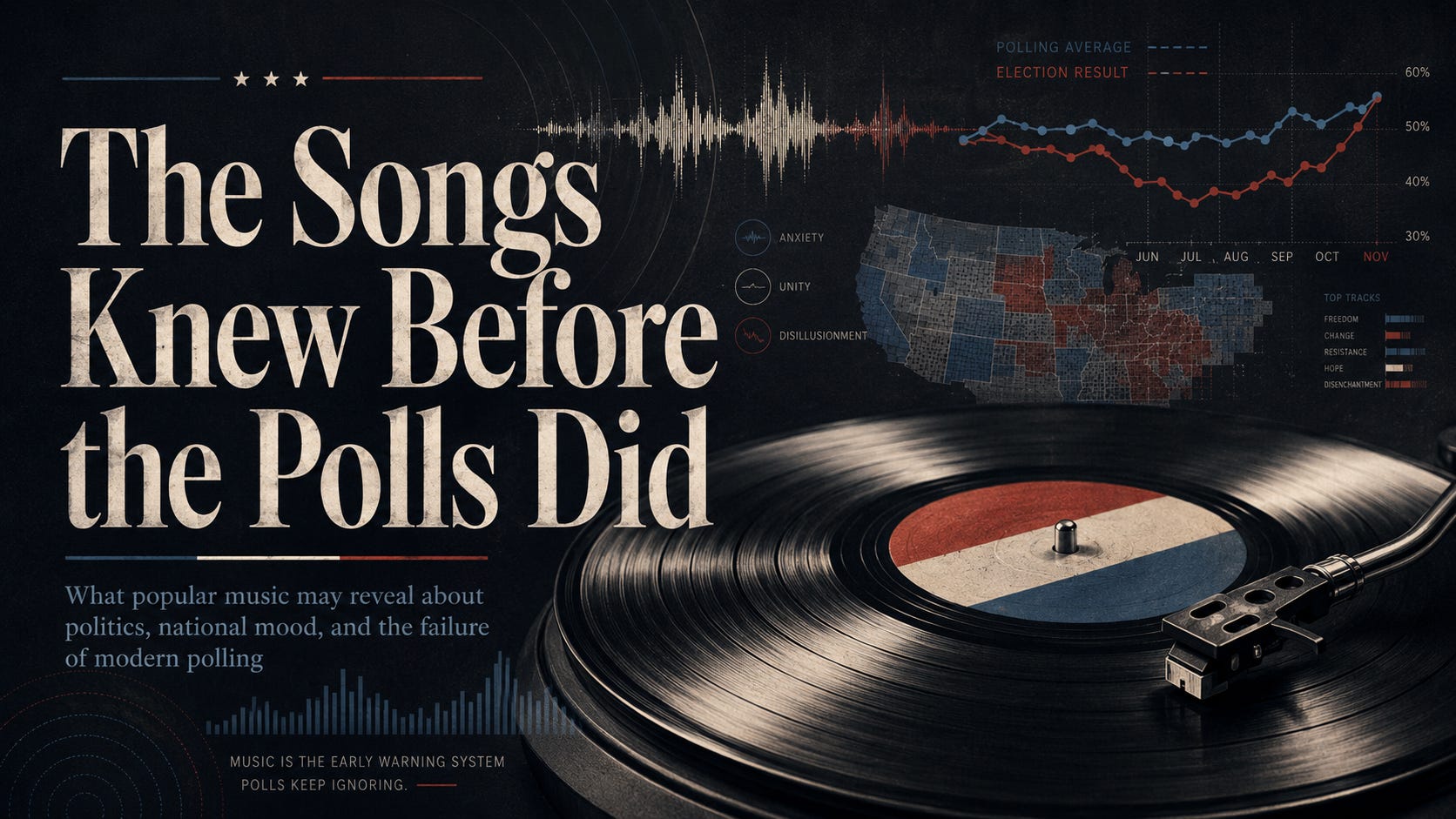
The Songs Knew Before the Polls Did
What popular music may reveal about politics, national mood, and the failure of modern polling
In the summer of 1840, the Whig party ran a presidential candidate named William Henry Harrison against the sitting Democratic president, Martin Van Buren. Van Buren had won in 1836. He had Andrew Jackson’s blessing. He had the Democratic Party machine. He had four years of incumbency.
The Whigs had Harrison, an aging general with a reputation for living in a log cabin, and they had a campaign tune called “Tippecanoe and Tyler Too.”
That tune is what people sang at every rally, every barbecue, every cider party from Maine to Mississippi. It named the candidates. It mocked the opposition. It had a chorus you could remember after one hearing and shout while drunk. The Whigs handed it out in pamphlets and got it picked up by traveling fiddlers.
Van Buren had no song.
Harrison won 234 electoral votes to 60.
Horace Greeley, the Whig editor, wrote at the time that the songs were doing more good than anything else his side was running. He was not being romantic. He meant it as analysis. The professionals on the ground believed they were winning because they had a hit single.
This is a strange story to tell about a country that prides itself on rational politics.
It is even stranger when you notice that it happens again.
And again.
And again.
Five Encore Performances
Skip forward 92 years.
The Great Depression has driven unemployment to 25 percent. Herbert Hoover is the incumbent, running on his 1928 slogan from when things were good. Franklin Roosevelt has adopted “Happy Days Are Here Again,” a song from a 1929 movie that nobody in the America of 1932 actually felt happy enough to mean.
The song was absurd to the present moment. It promised a future the country could not yet see.
FDR won 472 to 59.
Skip to 1980.
Jimmy Carter has diagnosed the country’s “malaise” in a televised speech the press has been mocking ever since. Ronald Reagan is offering a movie-set vision of an America that does not technically exist but might. The popular music of the actual year was Pink Floyd’s “The Wall” and Blondie’s “Call Me,” sad and tired music for a sad and tired country.
Reagan won 489 to 49.
Skip to 2008.
Will.i.am has released a YouTube video called “Yes We Can” that sets Barack Obama’s New Hampshire concession speech to music with celebrity cameos. The video is watched 26 million times in its first month. Jay-Z performs at Obama rallies. Bruce Springsteen plays for him.
John McCain’s campaign cannot get a single artist to license a song. They try ABBA. The artist sends a cease-and-desist letter.
Obama won 365 to 173.
Skip to 2024.
A country song called “Try That in a Small Town” reaches number one in July 2023, and a Virginia farmer named Oliver Anthony debuts at number one a month later with “Rich Men North of Richmond.”
Both songs become rally fuel for the populist right. Trump plays them constantly. The Harris campaign uses Beyoncé and Charli XCX, both genuinely popular but in a different country than the country those two songs describe.
Trump won the popular vote and 312 electoral votes.
That is five elections, across 184 years, in which the candidate whose musical mood matched the country’s musical mood won decisively.
You can dismiss any one of these as coincidence.
Dismissing all five at once requires more confidence than I have.
The Quiet Body of Evidence
There is also actual academic literature on this, which is the part that makes the story go from cocktail-party anecdote to actual question.
In 1991, a psychologist named Harold Zullow published a study in the Journal of Economic Psychology. He had content-analyzed the lyrics of 1,344 Billboard top-40 songs from 1955 to 1989 for two specific psychological traits: rumination about bad events, and pessimistic explanatory style.
Then he checked whether those traits predicted anything.
They did.
Pessimistic rumination in pop lyrics led GNP growth changes by one to two years. In May 1990, Zullow used the model to publicly call the 1990-91 recession before economists did.
He was right.
A year earlier, Zullow and his collaborator Martin Seligman, the Penn psychologist who would later become famous for “learned helplessness” and positive psychology, had published a related finding. They had measured the optimism in presidential nomination acceptance speeches from 1900 to 1984.
The more optimistic candidate won 18 of 22 elections.
The optimism gap predicted the size of the Electoral College margin with eerie precision.
Seligman was so confident in the model that he bet 17,000 dollars of his personal savings on Michael Dukakis in the 1988 election.
He lost.
We will get to why.
In 2009, a psychologist at Coastal Carolina named Terry Pettijohn put forward what he called the Environmental Security Hypothesis: in threatening economic and social times, the popular songs that climb to the top of the charts get longer, more meaningful, more romantic, and more focused on the future.
In safe times, hit songs get shorter, sillier, and more individualistic.
He found the pattern across every Billboard number one from 1955 to 2003.
In 2018, an economist named Hisam Sabouni discovered that the average emotional positivity of music being streamed on Spotify in a given week leads the Michigan Consumer Sentiment Index by several days.
People are streaming the country’s mood several days before the country can articulate it to a pollster.
In 2012, a finance professor named Philip Maymin published a paper showing that the rhythmic variance of Billboard top 100 songs is negatively correlated with stock market volatility.
When listeners want steady music, the markets are about to get turbulent. When listeners want turbulent music, the markets are about to get steady.
The signal is statistically significant and the trading edge it produces is worth roughly 2.5 volatility points per year.
This is, to be clear, peer-reviewed academic work in respectable journals.
Not folklore.
Not Halloween-mask theory.
Not whatever the Washington Redskins were doing to the polls in the 1990s.
Real social science showing that the sounds Americans choose to listen to encode information about the country’s psychological state that arrives on the chart before it arrives anywhere else.
Where It Falls Apart, A Little
The Seligman finding has a problem, and the problem is the interesting part.
After 1988, the optimism model stopped working.
Every presidential nominee from George H. W. Bush forward had read the same political science Seligman had read, and they all rewrote their convention speeches to sound optimistic.
Bob Dole proclaimed himself “the most optimistic man in America.”
Bill Clinton ran as “the man from Hope.”
Obama ran on hope literally.
The optimism gap between nominees collapsed to nothing, and the model collapsed with it.
The lesson is unsettling.
The thing that was predictive lost its predictive power the moment it became operational. Once the campaigns optimized for the metric, the metric stopped meaning anything.
This is a recurring pattern in social science forecasting and it should make anyone selling a music-predicts-elections framework slightly nervous.
There are other rough edges.
The popular music of 2016 was Drake, Adele, Justin Bieber, none of it grievance-coded, and the grievance country canon that would later dominate 2023 did not yet exist. A purely chart-based model would have called 2016 for Hillary Clinton.
She lost.
The 1992 election looks like a clean Clinton music story, Fleetwood Mac, saxophone on Arsenio Hall, until you notice Ross Perot ran as an independent and took 19 percent of the popular vote, mostly out of George H. W. Bush’s pocket.
Without Perot, music probably loses that one.
The 1948 election looks like a country music story until you notice that Hank Williams’s first hit was in early 1949, after the election was over.
So the model is interesting.
The model is also imperfect.
The model fails specifically when campaigns figure out what it is measuring and start gaming it.
Which is also a clue.
The Bigger Question
Here is what I cannot stop thinking about.
If the popular music of a country, the songs that bubble up to the top of a chart through millions of uncoordinated individual choices, can encode psychological information that leads consumer sentiment, GNP growth, market volatility, and at least some election outcomes, then music is not a fluke.
Music is a sensor.
It is a sensor that measures something Americans will not say to a pollster, do not yet know about themselves, and cannot easily fake.
The Billboard chart cannot be reweighted by a likely-voter screen.
The chart cannot be ghost-called by an autodialer to a dead landline.
The chart is what 100 million people actually did with their attention last week.
The only way to fake it is to change what 100 million people are actually doing with their attention.
If that is true of music, the obvious next question is:
What else?
What other things do Americans do with their bodies, their wallets, their cars, their evenings, that might encode the same psychological information faster and cleaner than any poll?
The TSA turnstile cannot be spun.
The vasectomy rate cannot be talked over.
The silver coin sitting in a vault in West Point does not care what the cable news cycle wants you to feel about the economy.
Polling has had its worst decade in living memory.
Response rates are in the single digits.
Likely-voter screens have failed in three consecutive presidential cycles.
The industry that built itself around landline calls in the 1970s is trying to read a 21st-century mood with a 20th-century tool, and it is failing.
What if the music study is the canary?
What if there are a hundred of these sensors, sitting around in plain sight, each measuring a different facet of the national mood, and the only reason we have not assembled them into a unified national vibe-meter is that nobody has bothered?
That is part two.
Coming In Part Two
The hundred-indicator national mood index.
The post-Dobbs vasectomy boom and what it actually means.
Why backyard chicken coop permit applications might be a leading indicator of something nobody wants to admit.
What the TSA passenger volumes say about Florida that the polls do not.
The U-Haul migration index.
The lipstick-shaped recession signal.
The license-plate-frame map of America.
Five or six things you have been doing without realizing you were also voting.
For now, file this away:
The songs of an era seem to know things about that era’s politics that the era itself does not yet know it knows.
That alone is worth a few more weeks of attention.
I will see you in part two.
A Note On What This Essay Is And Is Not
This is a thought piece.
It is not a forecast.
The author runs a political data firm that is, as of this writing, building a behavioral mood index inspired by the questions raised here. The first public version of that index launches soon and you’ll be notified.
None of the forecasts on that site are presented as anything other than experimental.
Where the model is wrong, the dashboard says so, on the same page where the prediction was made.
That is how forecasting should work.
DBW
About the Author
David B. Wheeler is President and Co-Founder of American Muckrakers, the political accountability organization best known for exposing hypocrisy, corruption, and public foolishness wherever it hides.
He has spent 40 years building businesses, working in more than 50 countries and all seven continents, and occasionally annoying powerful people who richly deserved it. He writes about politics, accountability, misinformation, civic decay, and the strange patterns hiding in plain sight.
Disclaimer
This essay constitutes protected speech and commentary, opinion, and advocacy on matters of public concern under the First Amendment to the United States Constitution. It is not a legal pleading, sworn statement, affidavit, or admission of fact, and it does not purport to describe evidence, discovery, or litigation strategy. This commentary is not intended to influence any pending judicial proceeding. Nothing herein waives any rights, concedes any legal position, or limits the author’s ability to pursue or defend lawful claims in any forum.


