

Florida Elected CFO Sent Four Armed Agents to a 77-Year-Old Veteran Over a Postcard
The postcard said, “You lack values.” Public records show how ordinary political criticism became a criminal threat assessment, how much taxpayer funds it consumed, and why Floridians should be pissed

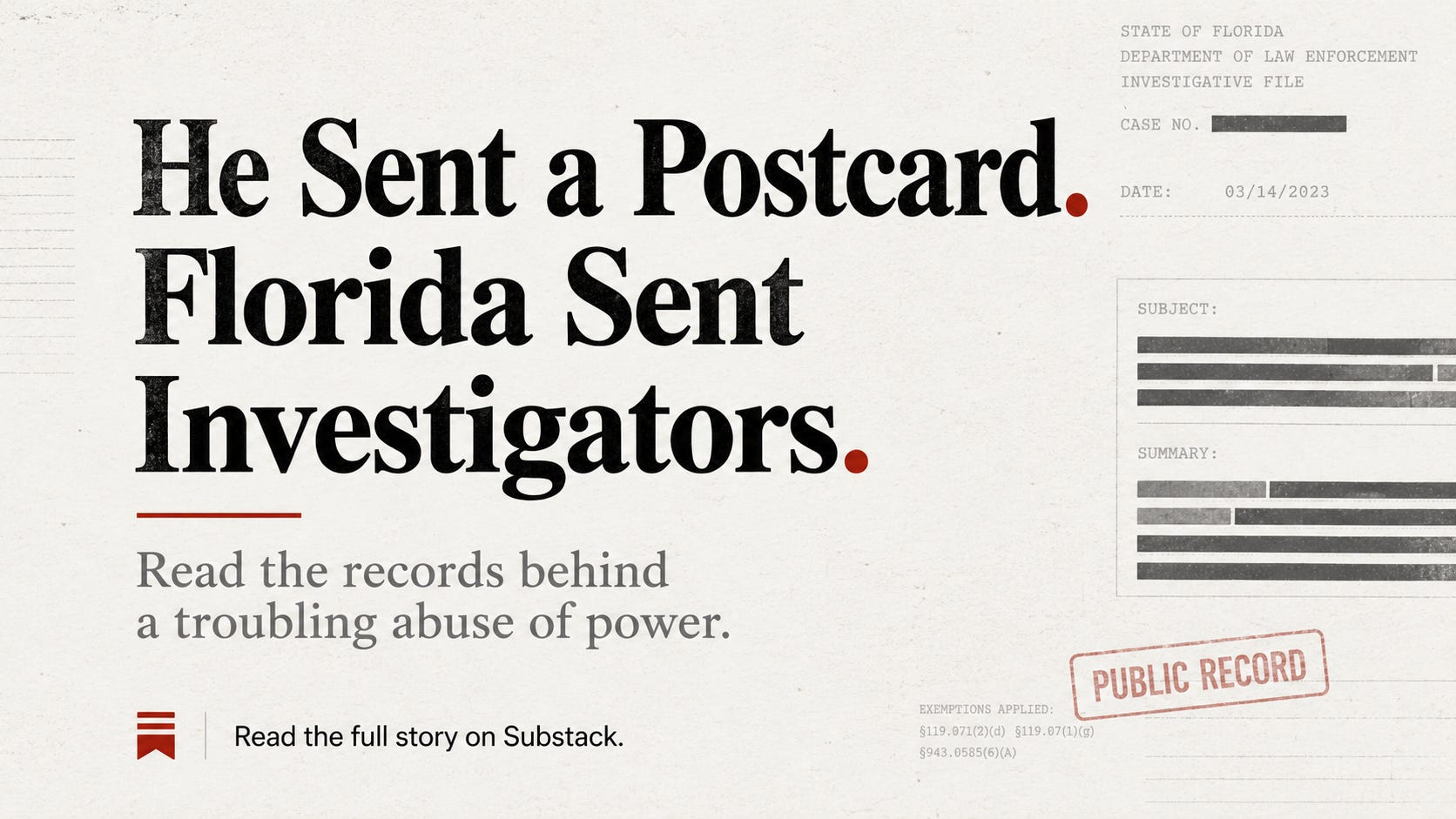
PUBLIC RECORDS • FIRST AMENDMENT • FLORIDA BULLSHIT
STORY UPDATED ON JULY 14, 2026, WITH STATEMENTS FROM THE O’GARAS & the OFFICE OF CHIEF FINANCIAL OFFICER BLAISE INGOGLIA.
Mr. James O’Gara mailed a postcard to Florida Chief Financial Officer Blaise Ingoglia. It contained three words: “You lack values.”
That was not a threat. It was not even ambiguous. It was criticism, the kind of blunt, unpleasant, constitutionally protected criticism public officials receive every day.
Florida responded by sending two armed investigators from the Department of Financial Services’ Criminal Investigations Division to the home James shares with his wife, Cathy. The agents questioned him and then interviewed two neighbors. The encounter was entered into the department’s ACISS case system as Case No. 25-3226.
The public-records file and the recorded interview do not prove that Ingoglia personally ordered the visit. But, he has a reputation as a control freak and desperatly wants to keep his office. But they do show senior officials inside the department transforming a harmless postcard into a formal “threat assessment,” routing it down a law-enforcement chain of command and dispatching investigators who themselves repeatedly acknowledged that O’Gara had done nothing wrong. (Review the full public documents below.)
And they show something else: the sheer, absurd scale of the government effort to make this a big fucking deal. The state that brags about hunting waste burned a full work week of public payroll on three words from a retired Army veteran.
The numbers
I requested the records. Getting them took a fight of its own. I requested and paid for these records in October 2025, while the story was still fresh. The Department of Financial Services did not produce them until July 2026, roughly nine months later. I had to pester them. Florida's public-records law contemplates production within a reasonable time; nine months for a batch of emails is not that. It is long enough for a news cycle to die, an election cycle to turn, and the officials involved to hope everyone forgot. Add whatever it cost to slow-walk one records request to the tab below.
Here is what production 4638-2025 shows, by the numbers:
2,323 pages produced in response to a single public-records request, totaling roughly 295,000 words
At least 38 distinct emails about the postcard, appearing more than 50 times across the production once you count the copies bouncing between inboxes
22 or more separate people on those emails: state law-enforcement brass, executive staff, communications aides, city police commanders and reporters
Roughly 7,800 words of postcard-related correspondence spread across 50 pages of the production
Two armed investigators at the O’Garas’ door, with two more agents in unmarked black Broncos staged down the street, according to Cathy O’Gara’s written account, plus two neighbors interviewed
One recorded interview, just under eight minutes, logged as ACISS Case No. 25-3226
Zero threats found. Their words, not mine.
Zero apologies. Anywhere in 2,323 pages. To anyone.
The order was explicit
On September 15, 2025, then-Criminal Investigations Division Director Simon Blank wrote: “The attached was mailed to the CFO. Can you have someone look into the name and do a threat assessment?”
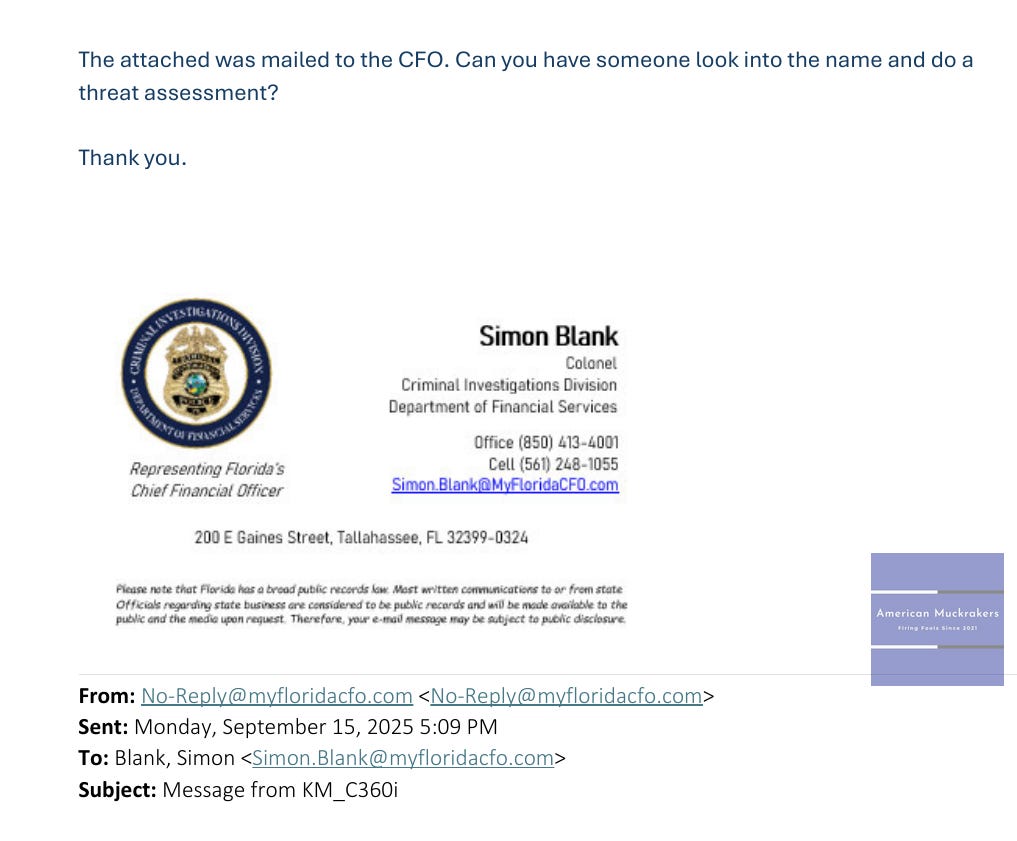
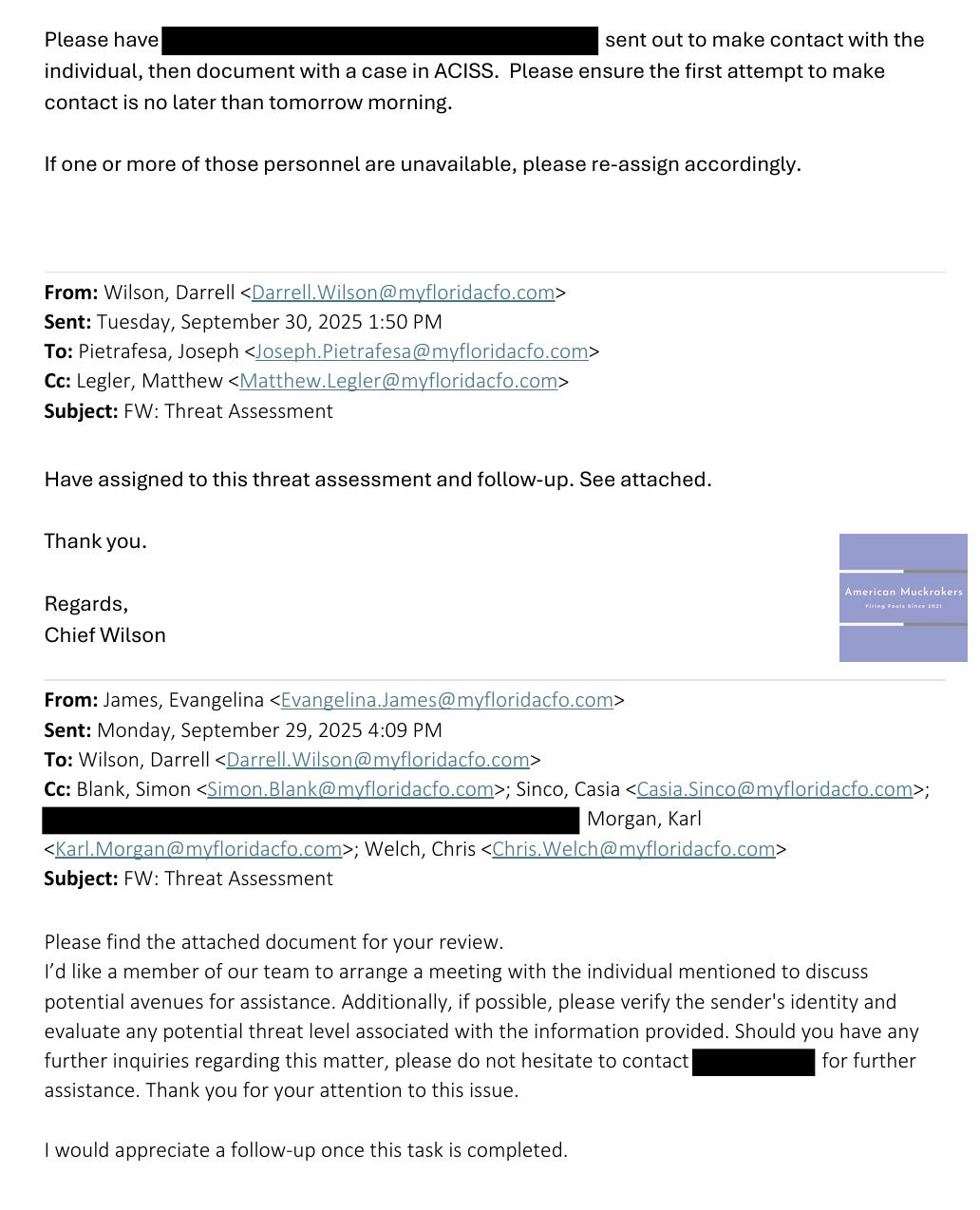
Two weeks later, the request was moving through the chain of command. A senior official asked staff to verify the sender’s identity and “evaluate any potential threat level.” A chief assigned personnel, ordered an attempt to make contact by the next morning and directed that the encounter be documented as a case in ACISS.
The bureaucratic language is revealing. The agency described the proposed interview as a meeting to discuss “potential avenues for assistance.” But the task was assigned as a threat assessment, handled by criminal investigators and entered into a criminal case system.
The agents said the quiet part out loud
The interview audio is more embarrassing than any editorial flourish could be. One investigator told O’Gara: “Yeah, look, you didn’t do anything wrong.” Later, an investigator repeated: “I looked at your postcard and was like, you didn’t do anything wrong.”
O’Gara answered with the obvious question: Why were armed investigators at his house if he had done nothing wrong? He told them, “I have a right to voice my opinion,” and said the visit would make him exercise that right even more. Asked whether the postcard carried some hidden meaning, he answered: “His values suck. That’s all I said.”
O’Gara, a two-tour Army veteran who re-enlisted after September 11, told the agents he has mailed roughly 200 similar postcards to elected officials at the state and federal level, up to and including President Trump. Only one office responded by sending armed men to his home. On tape, he made his position plain: he was pissed that they were sent, the visit was totally inappropriate, and it was not the agents’ fault.
The investigators were courteous. This is not primarily a story about two field agents doing an assignment they were handed. It is a story about the officials who handed them the assignment, and the institutional judgment that turned criticism into a police matter.
Listen to the audio from the actual interview here:
The department’s own report found no threat
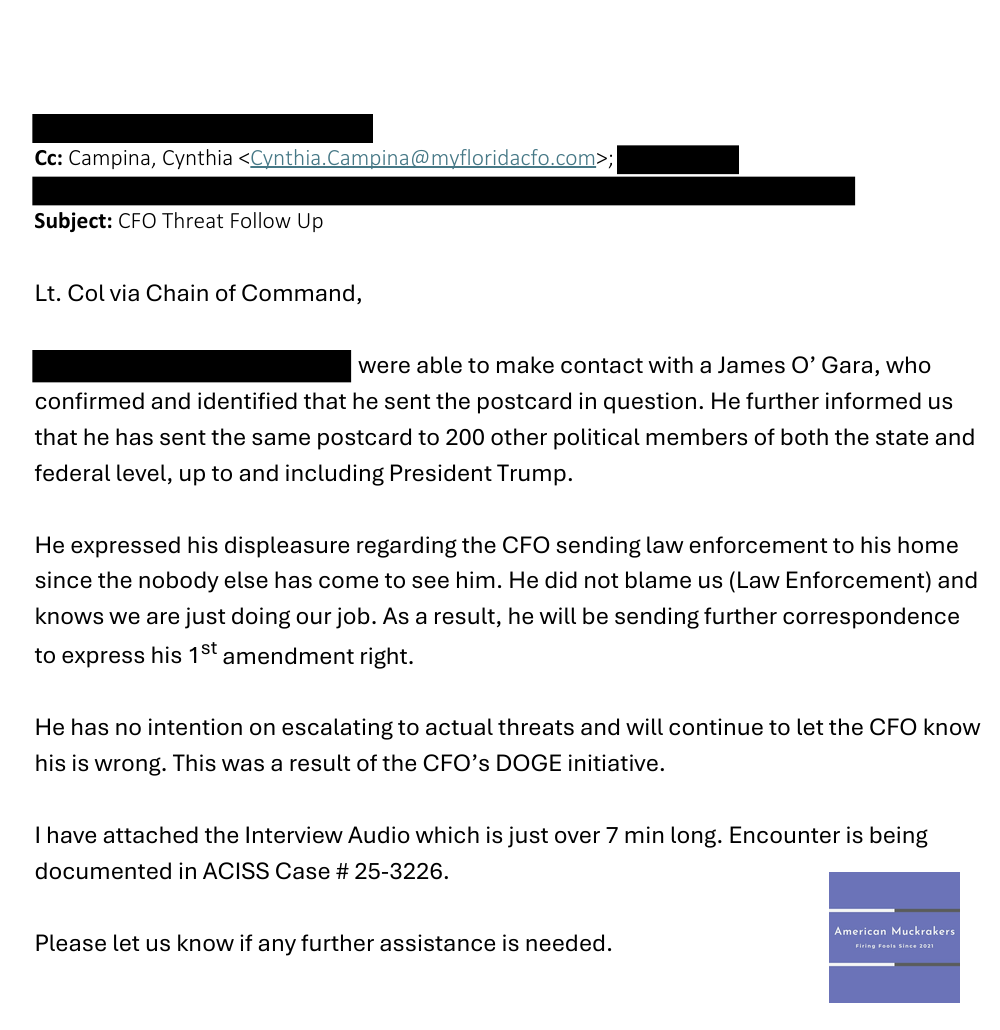
The follow-up report says O’Gara had sent similar postcards to roughly 200 political figures, including President Donald Trump. It records that he had “no intention on escalating to actual threats” and would continue writing to the CFO as an exercise of his First Amendment rights.
That should have ended the matter before investigators ever reached his front door. Instead, the state created a law-enforcement record after the fact documenting that the citizen was not a threat.
Meanwhile, an 11-year-old hid inside
While the agents stood at the door, Cathy O’Gara’s 11-year-old granddaughter was inside the house, frightened. The men wore vests marked POLICE, presented no identification and gave no names. When Mrs. O’Gara left to drive her granddaughter to school, she passed two unmarked black Broncos with two more agents down the street.
She did what any sensible person would do: she emailed the Largo police chief to ask whether the visit was even legitimate.
“This morning 2 men dressed in brown clothes, no insignias knocked on our door... My granddaughter, 11, was inside and very afraid... Are we, as a city, going to allow intimidation tactics by law enforcement of any kind? Please protect us. Our children are actually afraid.”
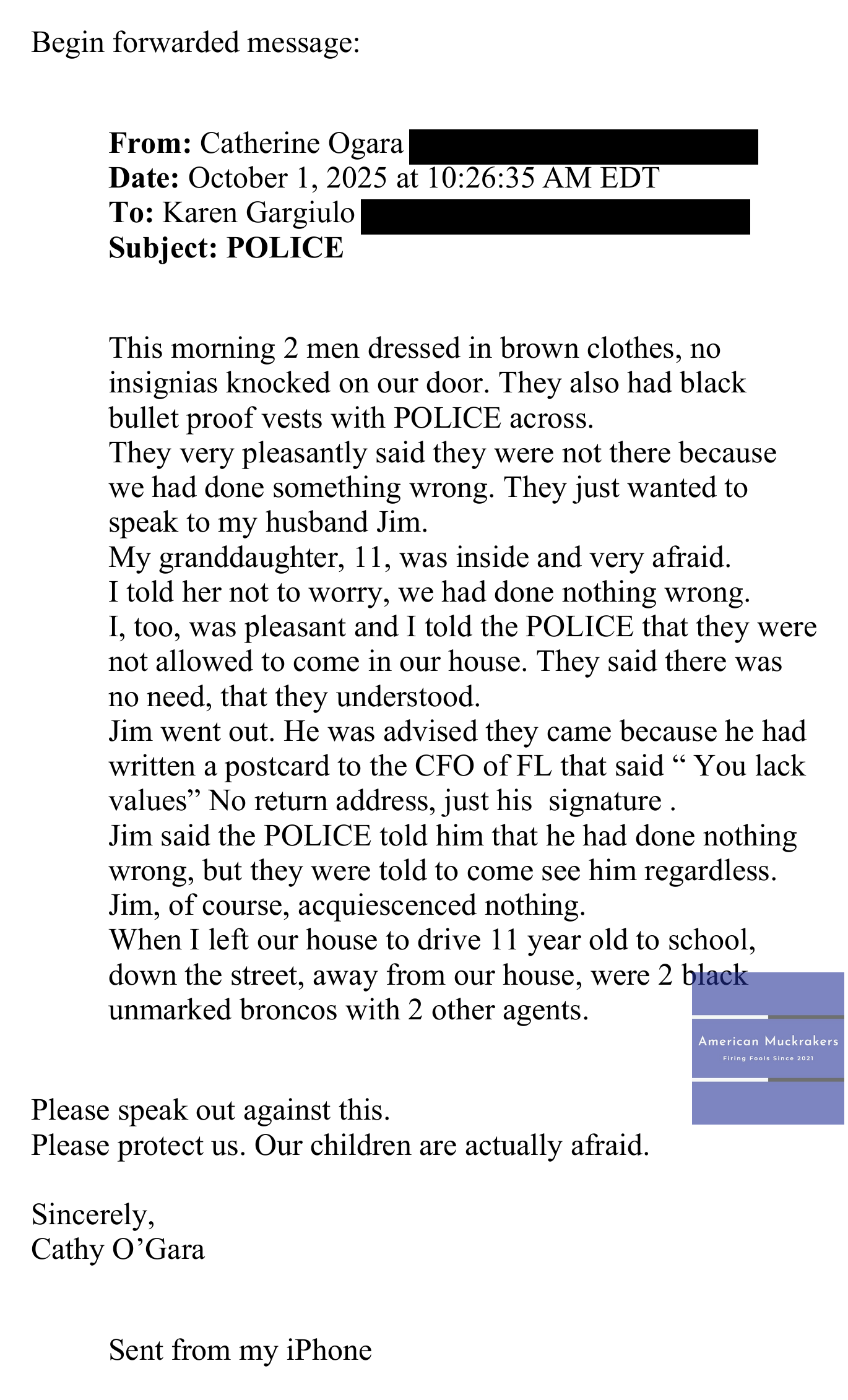
That email triggered its own mini-investigation. A Largo Police Department major and a lieutenant traced the mystery agents, looped in the Department of Financial Services and confirmed to the family that yes, the men who would not identify themselves were state officers. Add a city police department’s time to the tab.
Then came the public-relations dodge
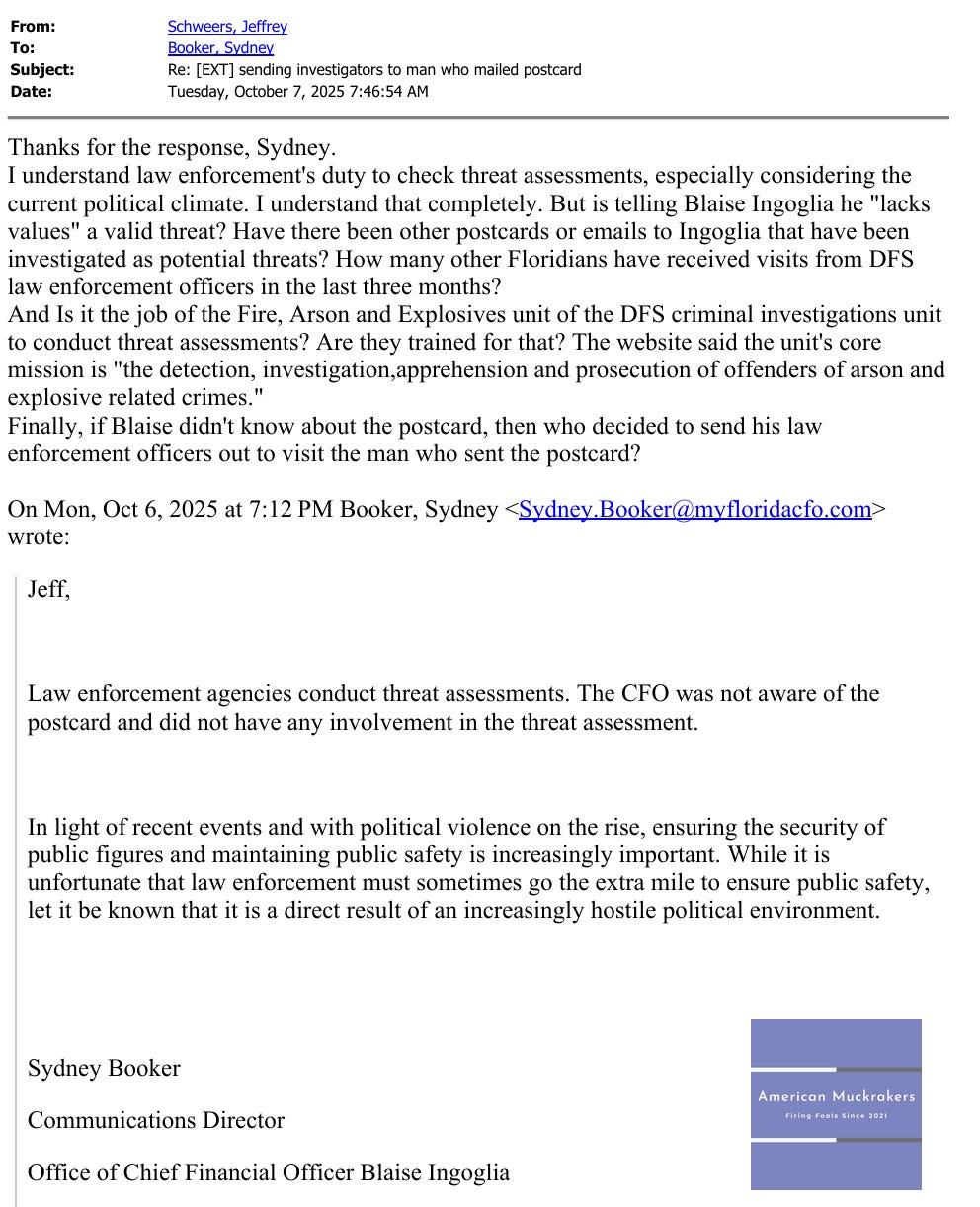
When reporters began asking questions, Ingoglia’s communications director repeatedly issued the same statement: the CFO did not see the postcard, did not direct the assessment and the decision was made “solely by law enforcement personnel.” The statement then praised the CFO as a conservative believer in free speech.
The records support the narrow statement that they do not show Ingoglia personally ordering the investigation. But the broader response is evasive. The “law enforcement personnel” were senior officials within the Department of Financial Services, the department led by the CFO. The internal email did not describe a specific threatening word, act or circumstance. It said the item had been mailed to the CFO and asked for a name check and threat assessment.
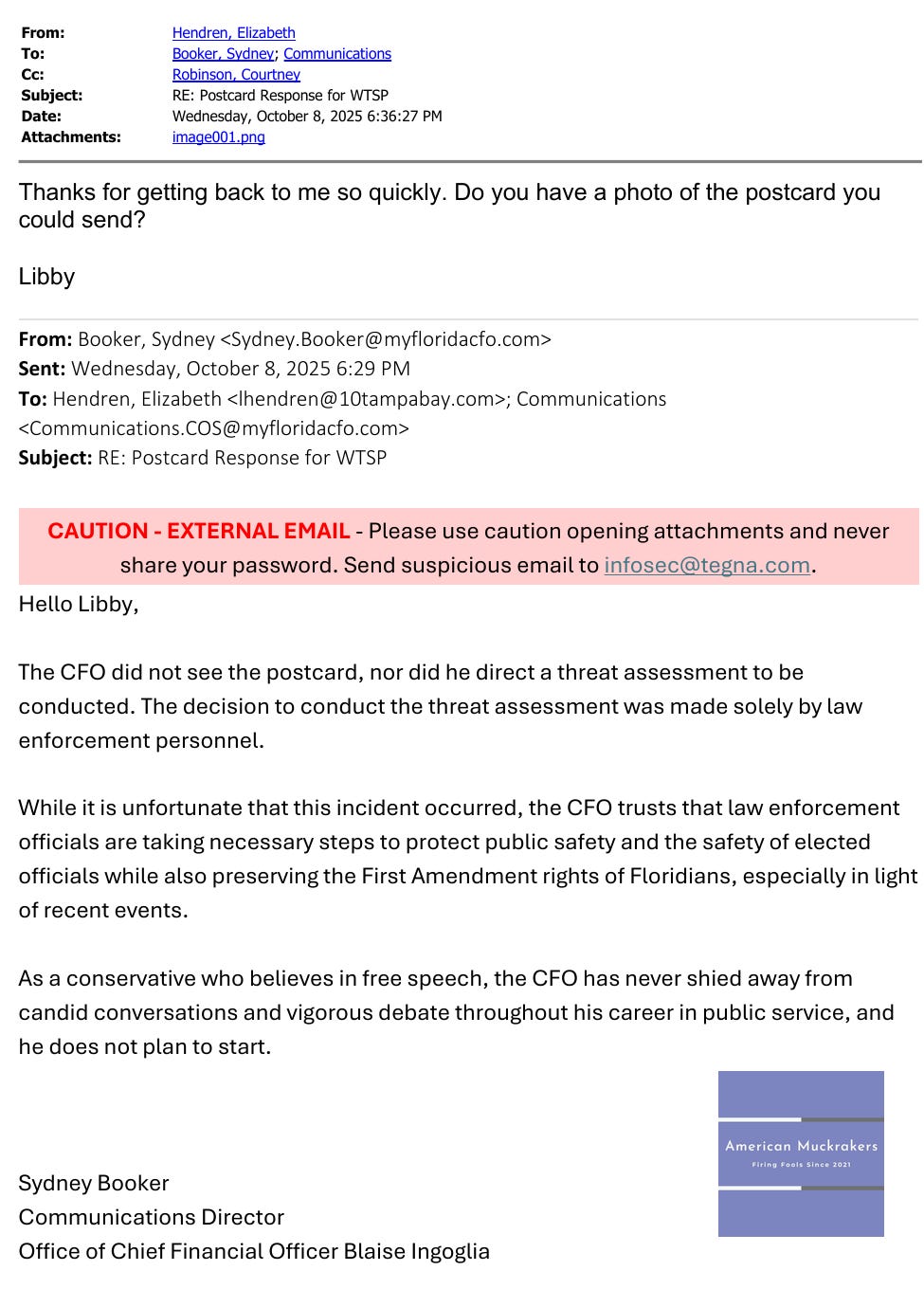
The production also contains a two-line email that complicates the tidy “arm’s length” story. On October 1, hours after the doorstep visit, Deputy CFO Julie Jones, who oversees the department’s law-enforcement division, wrote under the subject “Talked to Simon”:
“Postcard came from Sydney. Can I see it?”
Sydney Booker is the communications director. Per the department’s own top law-enforcement executive, the postcard routed through the CFO’s communications shop, and she herself had not seen it after her agents had already been to the man’s door.
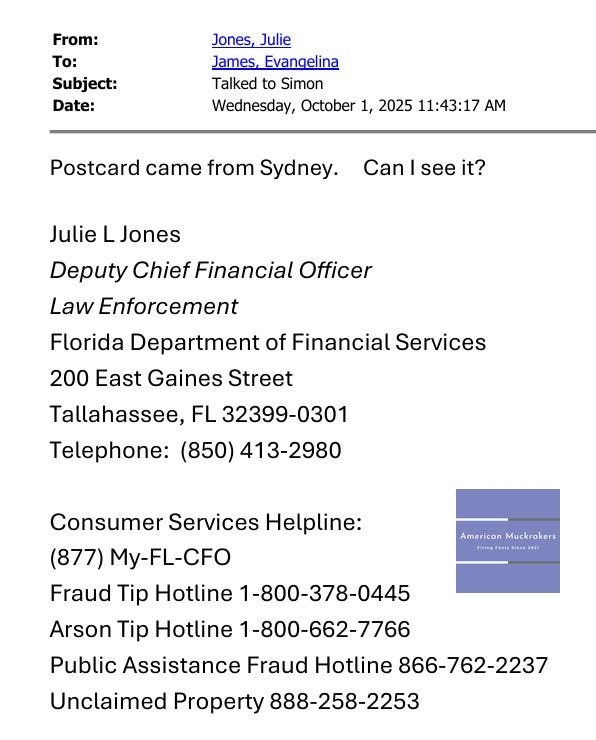
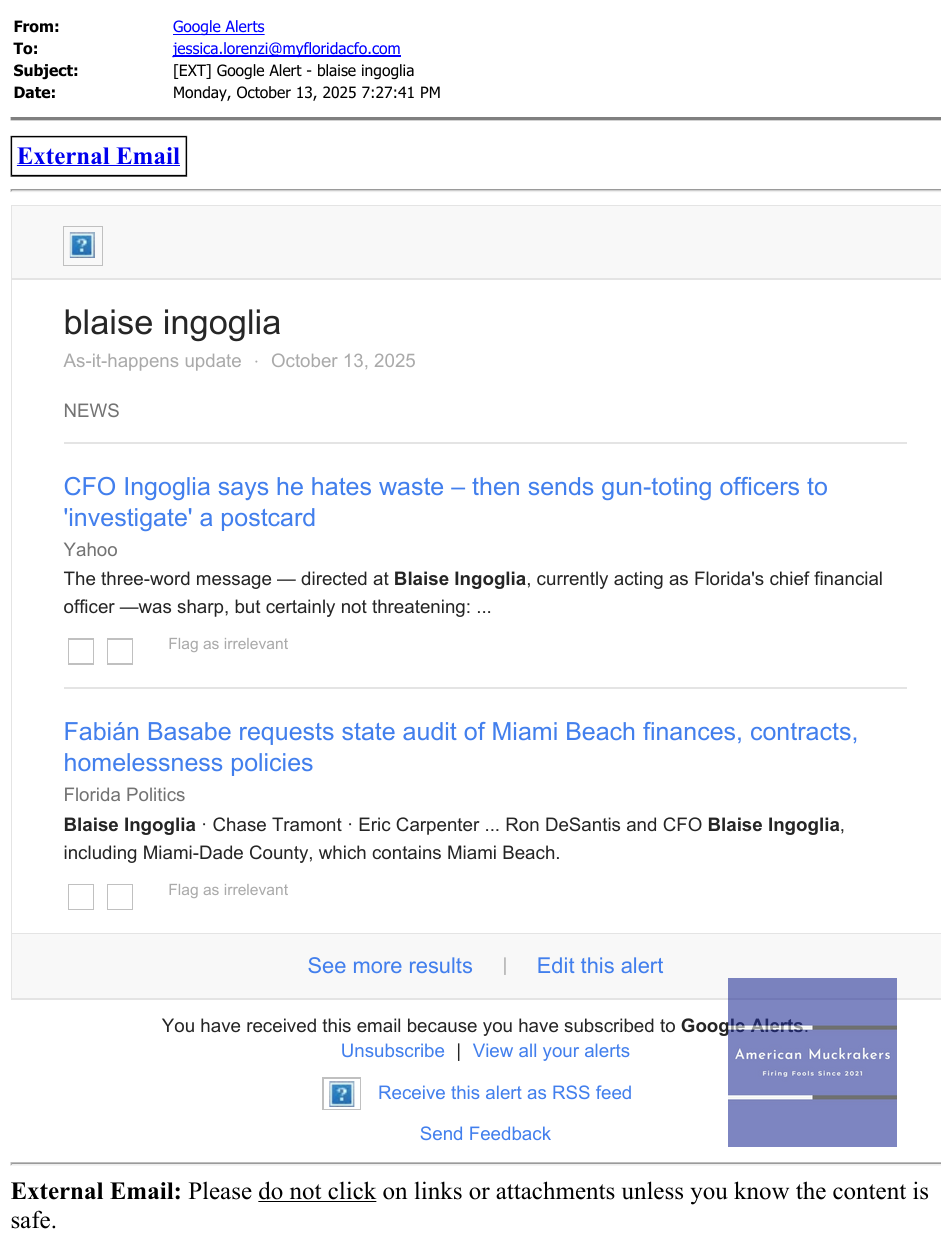
The Orlando Sentinel’s Jeff Schweers put the hard questions to the office directly: Is telling Ingoglia he “lacks values” a valid threat? Why was the Fire, Arson and Explosives unit, whose stated mission is investigating arson and explosives crimes, running threat assessments on postcards? And if Blaise did not know about the postcard, who decided to send his law-enforcement officers out? The production contains no substantive answer to any of them.
The Sentinel’s editorial board later summed it up in a headline the CFO’s own staff dutifully forwarded around the office: Ingoglia says he hates waste, then sends gun-toting officers to investigate a postcard.
The bill
Let’s total this up. These are my estimates, built from the documents, and I have kept them deliberately conservative.
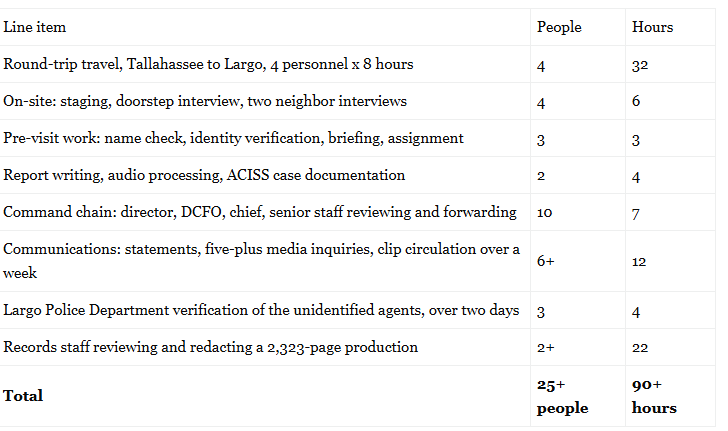
Call it a full work week and then some, spread across two agencies and a criminal case system, spent on three words mailed by a veteran. That total does not include the CFO’s DOGE teams, whose government-waste road show was the reason for the postcard in the first place. The man auditing counties for excessive spending ran up this tab over a piece of mail.
No apology
Here is the part that should bother you most. In 2,323 pages, there is not one apology. Not to Mr. O’Gara, whose protected speech earned him armed visitors. Not to Mrs. O’Gara, who had to email a police chief to find out who had been at her door. Not to an 11-year-old who watched men in POLICE vests come to her grandparents’ home and was, in her grandmother’s words, “very afraid.” No apology has been made since, either.
Instead, the office’s official position blames the weather: the visit was “a direct result of an increasingly hostile political environment.” The hostile environment, in this telling, was created by the retiree with the postcard, not by the office that sent armed agents to his house.
CFO Says The O’Garas Deserved A Visit From Law Enforcement Due to Assassination of Charlie Kirk
“This postcard was received within days of the brutal and tragic assassination of Charlie Kirk, during a period of heightened vigilance for law enforcement agencies responsible for assessing potential threats to public officials. The Department of Financial Services and the CFO have always respected Floridians’ First Amendment rights, and the Department has continued to receive postcards from the O’Garas and other constituents on a regular basis. The Department has also updated its threat assessment processes within the Criminal Investigations Division.”
Sydney Booker, Communications Director, Office of Chief Financial Officer Blaise Ingoglia
What is embarrassing, and what may be legally serious
The embarrassing part is established by the records. A statewide elected official’s department deployed criminal investigators over three words of political criticism. Investigators who saw no threat were required to check anyway. Neighbors were questioned. The contact was memorialized in the department’s ACISS case system. Then the office defended the process by claiming to protect the very First Amendment rights the process predictably chilled.
Calling the conduct criminal, however, would go beyond the evidence currently available. The documents do not establish corrupt intent, and they do not show Ingoglia personally initiating the assessment. The strongest legal concerns are constitutional and administrative, not a proven criminal offense.
1. A possible First Amendment retaliation or chilling-effect claim. Criticism of an elected official sits at the core of protected political speech. The U.S. Supreme Court has said that government officials generally may not subject a person to retaliatory action because of protected speech. A viable lawsuit would still require proof of adverse action, retaliatory motive and causation. The public records raise those questions; they do not resolve every element.
2. No apparent statutory threat. Florida’s written-threat statute concerns threats to kill, cause bodily injury, conduct a mass shooting or commit terrorism. “You lack values” contains none of those things. The records released so far do not identify another statement by O’Gara that would fit that definition.
3. A serious mission and jurisdiction problem. The Criminal Investigations Division publicly describes its work as fraud, arson, explosives, public-assistance fraud and theft or misuse of state funds. Ordinary criticism of the CFO is not listed. The department may have protective responsibilities not fully described on that page, but it should be required to identify the legal authority, written policy and objective criteria used here.
4. A possible misuse-of-office issue, but the current proof is incomplete. Florida ethics law prohibits a public officer or employee from corruptly using a public position or public resources to secure a special privilege or benefit. Retaliating against a critic with state resources could raise that issue. Yet “corruptly” is an important element, and the existing production does not prove it. An ethics accusation should be based on additional evidence about motive, authorization and comparable cases, not assumption.
The questions Florida still owes the public
What exactly was attached to the September 15 email that triggered the assessment, and why was it omitted from the production?
Who first decided the postcard should be routed to the Criminal Investigations Division?
What written policy defined this as a potential threat?
Why were two neighbors interviewed after agents concluded the postcard was not threatening?
Was ACISS Case No. 25-3226 closed, retained, disseminated or expunged?
How many similar political messages have produced home visits, and were the senders’ political viewpoints recorded?
How much staff time and public money did this episode consume? My conservative estimate above is 49 hours and counting. The department should produce its own accounting.
What, precisely, did the department change when it later said it had updated its threat-assessment processes?
Will anyone apologize to James and Cathy O’Gara?
Send the CFO a lawful postcard
The proper answer to an attempt, intentional or not, to chill political criticism is more political criticism. Send one peaceful postcard to the public office of Florida Chief Financial Officer Blaise Ingoglia. Do not threaten anyone. Do not contact a private residence. Do not target staff members. Use the public office address and say exactly what you mean:
“You have no values. Leave James and Cathy O’Gara alone, you political hack.”
MAIL TO:
Chief Financial Officer Blaise Ingoglia
Florida Department of Financial Services
200 East Gaines Street
Tallahassee, Florida 32399
One postcard per person is enough. Sign your name if you choose, the way Jim did. Keep it nonviolent, lawful and unmistakably political. Public officials are not entitled to insulation from criticism, and state law-enforcement resources are not a customer-service department for bruised political egos.
James O’Gara’s first postcard said, “You lack values.” The records do not rebut him. They make his point. And if the CFO’s office wants to run threat assessments on a few thousand more postcards, we already know what one costs.
Hear it from the O’Garas themselves
Jim and Cathy O’Gara joined me and my co-host, Colonel Moe Davis, on the MUCK YOU! podcast to tell the whole story in their own words: the knock at the door, the unmarked Broncos, the badge Jim could not read because the agent kept it turned away, and what it did to their grandchildren. They are funny, unbowed, and exactly the kind of citizens this country is supposed to produce. Listen to the full episode here: Florida Veteran’s Message to Official Unleashes Unprecedented Police Response.
Source notes
The Florida Department of Financial Services was offered the opportunity to respond to our story but we never heard anything prior to publication. The FL DFS was also offered the opportunity to appear on MUCK YOU! podcast to refute our reporting.
The FL DFS/CFO public-records production 4638-2025 (2,323 pages, approximately 295,000 words), especially pp. 13, 105, 107, 135, 136, 458 and 595. Email, word and participant counts computed from the full production; staff-hour figures are the author’s conservative estimates from the documents.
Audio: James O’Gara interview, October 1, 2025, ACISS Case No. 25-3226. Exact short quotations in this draft were cross-checked against the transcript published by Reason on July 6, 2026.
Florida Statutes § 836.10 (written or electronic threats).
Nieves v. Bartlett, 587 U.S. 391 (2019) (First Amendment retaliation principles).
Florida Statutes § 112.313(6) (misuse of public position).
Florida Department of Financial Services, Criminal Investigations Division, “About the Division.”

About the Author
David B. Wheeler is a journalist, political strategist, and the founder of American Muckrakers and Parallax Advisory LLC. He hosts the MUCK YOU! podcast and publishes accountability journalism at Muckrakers.Today. He has produced events in more than 75 countries and on all seven continents, including the first marathon in Antarctica. He lives in Western North Carolina and is a proud father of three and Iowa Hawkeye.
Disclaimer
This essay is opinion journalism based on public records obtained under Chapter 119, Florida Statutes, and on a law-enforcement audio recording released by the State of Florida. Document images are excerpted from Florida Department of Financial Services public-records production 4638-2025. Nothing in this essay alleges that any person committed a crime, and all individuals are presumed innocent of any wrongdoing. Staff-hour figures are the author’s estimates and are labeled as such. This publication and its call to action constitute political speech protected by the First Amendment. Readers who choose to write to public officials should do so lawfully, peacefully, and only at official public office addresses. Corrections: corrections@americanmuckrakers.com