
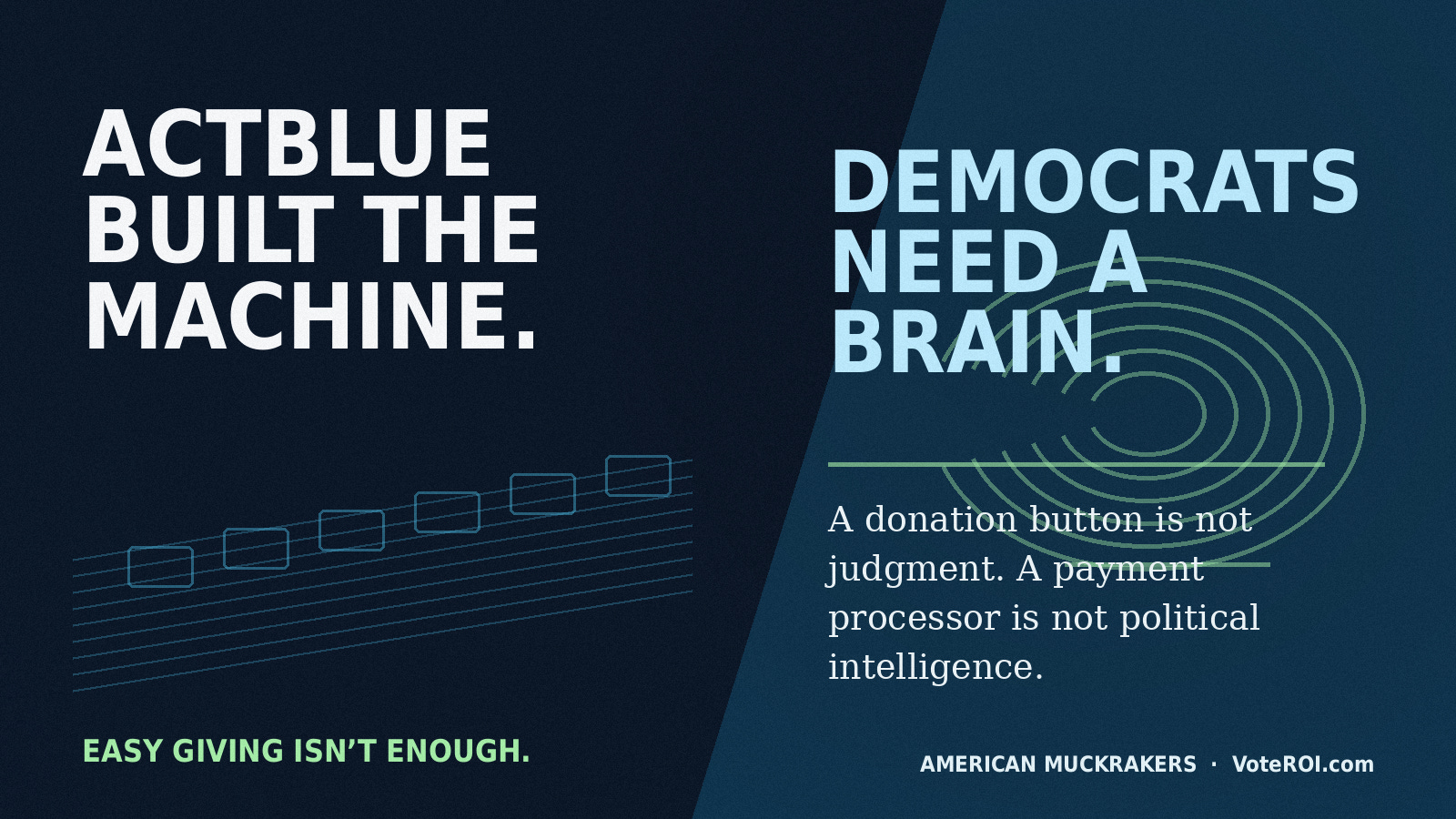
ActBlue Built the Machine. Now Democrats Need a Brain.
Democrats made giving easy. That was useful. Then we confused easy with smart.
Democrats made giving easy.
That was useful.
Then we confused easy with smart.
As we argued in Stop Donating Blind, the central problem in Democratic fundraising is not that donors lack passion. It is that too much passion is routed through too little strategy. Money moves fast. Judgment moves slowly. Consultants, unfortunately, invoice at the speed of light.
ActBlue is one of the most successful pieces of Democratic infrastructure ever built. Let’s say that plainly before anyone faints into a reusable tote bag.
Since 2004, ActBlue has helped Democratic candidates, progressive organizations, and causes raise billions of dollars. It gave campaigns a common set of donation rails. It helped turn small-dollar giving into a habit. It made online giving simple enough that millions of ordinary people could participate in politics without hiring a bundler, attending a wine cave reception, or pretending to enjoy small talk with a consultant named Chip.
That mattered.
ActBlue built a machine.
The problem is that Democrats built the machine and then, somewhere along the way, started treating the machine like a strategy.
That is where things went sideways.
A donation button is not judgment. A payment processor is not political intelligence. A familiar platform that lets donors give to almost anyone with a “D” next to their name is not the same thing as telling people whether their next dollar can still move a race.
ActBlue made giving easy.
Democrats still have not made giving smart.
The Beautiful Trap
The genius of ActBlue is also the trap.
It is easy. It is familiar. It works. A campaign can spin up a page quickly. A consultant can plug it into an email program. A donor can click, give, save a card, and go back to trying to survive the daily psychosis of American politics.
Convenience matters. Friction kills donations. ActBlue removed friction.
But friction is not the only problem in political giving.
Sometimes friction is the moment where a donor might stop and ask the only question that matters:
Should I actually give to this race?
ActBlue’s job is not to answer that question.
ActBlue’s job is to process the donation. It does that very well. Its official pricing page lists a 3.95 percent processing fee on contributions, along with other fundraising and campaign tools.
Fine.
But at scale, that fee is enormous. On a hundred dollars, 3.95 percent feels small. On a billion dollars, it is $39.5 million. On billions, it is real money.
More importantly, the platform gets paid whether the donation is brilliant, useless, sentimental, strategic, panicked, or inspired by an email subject line that sounds like a raccoon wrote it during a thunderstorm.
It gets paid if you give to a toss-up race that needs late money.
It gets paid if you give to a safe incumbent who does not need your money.
It gets paid if you give to a doomed campaign because a fundraising email made you feel guilty.
It gets paid if you give to a candidate who is inspirational, photogenic, doomed, and about to lose by double digits while the consultants invoice like champions.
That is not a conspiracy.
That is the model.
The machine does not ask whether the race is worth funding.
The machine asks whether your card clears.
Plumbing Is Not Strategy
Democrats love to congratulate ourselves for building infrastructure, and ActBlue really is infrastructure.
But plumbing is not strategy.
Plumbing moves water. It does not tell you whether the house is on fire. It does not tell you whether the foundation is cracked. It does not tell you whether you are watering a garden or flooding the basement.
ActBlue moves money.
It does not tell you whether the money matters.
That distinction is everything.
A giant wall of donation pages does not help a donor understand whether a race is winnable. It does not explain whether the candidate has a track record. It does not tell you whether the opponent is vulnerable. It does not compare the marginal value of your $50 in North Carolina against your $50 in a glamorous but hopeless House race with a great launch video, perfect lighting, and the electoral prospects of a houseplant.
The platform gives you access.
It does not give you judgment.
And that is how Democrats can raise oceans of money while still starving the races where another dollar might actually matter.
The Dreamy Candidate Problem
This is where everyone gets uncomfortable, which is usually where the truth is hiding.
Democratic donors love dreamy candidates.
You know the type. Great story. Great video. Great hair. Great moral clarity. Great line about democracy. Great photo with their kids, dog, grandmother, or rescue animal of unusual emotional intelligence.
They say the thing we wish more Democrats would say. They give us a little dopamine hit in the middle of a dark political year.
Then they lose by 14 points.
And the donor money is gone.
We have written about this before in Stop Donating Blind: admiration is not strategy. A campaign can be noble, brave, articulate, and structurally doomed at the same time. Politics is unfair that way. So is gravity.
Not because the candidate was bad.
Not because the cause was wrong.
Not because the donors were fools.
Because admiration is not strategy.
This is the sentence Democrats hate:
A good candidate is not always a good investment.
Some long shots are worth funding. Some are not. Some difficult races are structurally movable. Some are just political daydreams with ActBlue pages.
The problem is not that Democrats care too much. Caring is good. The problem is that too much of our donor culture converts emotion into money without passing through analysis first.
Republicans are not sentimental about power. MAGA has built a money train full of billionaires, small-dollar rage donors, dark money, media ecosystems, legal networks, and grievance merchants who understand that money must land where it produces power.
Democrats too often fund the candidate who makes us feel something.
That is how you lose winnable races while feeling noble about unwinnable ones.
The Donor Trust Problem
There is another issue Democrats should not ignore: donor trust.
ActBlue has faced scrutiny, litigation, congressional investigation, and public criticism. Some of that scrutiny is obviously political. Republicans would love to weaken one of the few Democratic infrastructure projects that actually works at national scale.
That part is not subtle. It is not even wearing a fake mustache.
Texas Attorney General Ken Paxton has sued ActBlue over alleged donation-practice issues. ActBlue has countersued, calling the Texas action unconstitutional retaliation and political harassment. House Republicans have also investigated ActBlue over donor verification, including questions about CVV requirements, prepaid cards, gift cards, and foreign-origin transactions.
ActBlue has denied wrongdoing, defended its compliance systems, and said it uses fraud-detection tools to review contributions and protect the platform.
Those are allegations and disputes, not final findings.
But donor trust is not a partisan issue.
Verification matters. Transparency matters. Security matters. Internal governance matters. If Democrats are going to ask millions of people to send money through a central platform, donors have a right to know how that platform protects them, how it protects campaigns, and how it protects the system.
Not because Ken Paxton says so.
Because donors deserve it.
Republican bad faith does not excuse Democratic complacency.
That sentence should be printed on a coffee mug and thrown through several conference-room windows.
The Labor and Governance Tension
There is also a labor story here, and Democrats should not pretend it does not matter.
In 2023, ActBlue laid off 54 employees, including union members. Union representatives criticized the cuts. ActBlue later reached a collective bargaining agreement with its tech workers union.
That does not make ActBlue evil. Organizations have budgets. Revenue changes. Management makes hard calls. Anyone who has ever run anything larger than a group chat knows that.
But Democrats should be honest about the tension.
A Democratic institution cannot live forever on worker-power branding, union language, and movement rhetoric while treating labor as expendable when the spreadsheet gets tight.
If our side’s fundraising infrastructure asks working people for money, it should be ready to explain how it treats working people inside its own walls.
That is not a Republican talking point.
That is a Democratic values test.
The For-Profit Question
There have also been reports of internal concern about whether ActBlue could move toward, or explore, a more commercial model.
To be clear: I have not seen a confirmed public filing, announcement, or official ActBlue statement saying it is converting to a for-profit company.
ActBlue still describes itself as a nonprofit.
But even the discussion is revealing. ActBlue has become so central to Democratic politics that questions about its business model, executive compensation, fees, governance, and future direction are no longer inside baseball.
They are donor questions.
They are party-infrastructure questions.
They are movement questions.
If a platform is indispensable, it should also be accountable.
Those two ideas are not enemies.
They belong together.
The Blind-Giving Industrial Complex
The Democratic fundraising universe has become very good at extracting money and much less good at explaining strategy.
The formula is familiar.
Find the outrage. Package the urgency. Add a countdown clock. Add a match. Add a terrifying subject line. Add a candidate photo. Add a little hope. Add a little doom. Shake vigorously. Send to list.
The donor clicks.
The platform processes.
The consultant reports a great quarter.
The race still loses.
Then everyone acts surprised when donors get tired.
Some donors have never given because the whole thing feels rigged, noisy, and manipulative. Some used to give and stopped because they watched their money vanish into races that had no path. Some still give out of habit, friendship, guilt, or fear, but they have stopped asking where the money lands.
That is not donor stupidity.
That is system failure.
The system was built to make giving easy, not to make giving wise.
Why This Keeps Costing Us Key Races
Democrats do not lose key races because of ActBlue alone. That would be too easy and too dumb.
We lose because of bad maps, weak local parties, poor candidate recruitment, billionaire Republican money, media asymmetry, voter suppression, bad messaging, bad timing, bad luck, and sometimes candidates who could not find a normal voter with both hands and a field plan.
But donor waste is real.
When money pours into celebrity races, it does not go somewhere else.
When donors fund hopeless campaigns because the candidate is inspiring, that money does not fund a winnable race in a cheaper media market.
When national attention turns one race into a donor magnet, quieter races with better marginal value get starved.
That is the opportunity cost nobody wants to talk about at the cocktail reception.
Every dollar has a next-best use.
If Democrats are serious about winning, we have to care where the dollar lands.
Not just whether it was raised.
What Donors Deserve
Donors deserve to know what they are funding.
They deserve to know who the candidate actually is.
They deserve to know the candidate’s track record.
They deserve to know whether the race is competitive.
They deserve to know whether the opponent is vulnerable.
They deserve to know whether their donation is funding voter contact, rural radio, digital noise, consultant fees, legal defense, ballot access, or another “we are almost there” email.
They deserve to know whether a race is a strategic long shot or a political fantasy.
They deserve to know whether their money still has marginal value.
That is the phrase that matters:
Marginal value.
The donor question should not be, “Do I like this candidate?”
The donor question should be, “Can my next dollar still change anything?”
Those are different questions.
Democratic fundraising keeps pretending they are the same.
Give the Money a Job
We started building VoteROI because, as we wrote in March-April: What we built, what we see, and the race we can win, too much Democratic money keeps flowing into races without enough regard for whether the next dollar can actually change the outcome.
That is not strategy.
That is political aromatherapy.
The point is not theoretical. In our Whatley Failed Western NC campaign, we explained exactly what a donor dollar would buy: billboards and rural radio in Western North Carolina calling out Michael Whatley’s failure to deliver Helene recovery.
That is what donor intelligence should look like.
Not “give because we yelled.”
Not “give because the clock is red.”
Not “give because democracy will die at midnight unless you chip in $7.”
Give because the money has a job.
A donor dollar should not be a scented candle for your anxiety.
It should be a tool.
Stop donating blind, damnit.
DBW
About the Author
David B. Wheeler is President and Co-Founder of American Muckrakers and a candidate for Clerk of Superior Court in Mitchell County, North Carolina. His views are his own, and written directly by David, with spell checking and minor edits with the help of his AI buddy. An essay, image, or story is never generated by AI and posted. That would be just stupid.
Disclaimer
Paid for by American Muckrakers Independent Expenditure PAC. Not authorized by any candidate or candidate’s committee.
This essay constitutes protected speech and commentary, opinion, and advocacy on matters of public concern under the First Amendment to the United States Constitution. It is not a legal pleading, sworn statement, affidavit, or admission of fact, and it does not purport to describe evidence, discovery, or litigation strategy. This commentary is not intended to influence any pending judicial proceeding. Nothing herein waives any rights, concedes any legal position, or limits the author’s ability to pursue or defend lawful claims in any forum.


